

On the Way
After visiting the Thangasserry Breakwater Tourism Park, I walked towards the next spot on my itinerary, a ruined fort.
On the way, I saw small stalls selling sweets and cold drinks. We Keralites call such stalls pettikadakal (“petti” means box, and “kadakal” means shops). Several autorickshaws were parked on the roadside, away from the auto stand. Withered under the afternoon sun, some drivers were taking a quick nap inside the rickshaws.
Nearby, a couple of local fishermen stood on the roadside, chit-chatting with each other. A few stray dogs on the street startled me, but they didn’t follow me or harm me in any way. Just before reaching the fort, I saw the D’Fort Ayurvedic Resort on the left. A few years ago, I used to visit this resort most mornings and evenings for nearly two months to attend my swimming class.
Finally, I reached my destination, the St. Thomas Fort.
History of St. Thomas Fort
Fort Thomas, St. Thomas Fort, Fortaleza de São Tomé, or Thangasserry Fort, is a ruined fort located in the beach town of Thangasserry on the shores of the Arabian Sea in the city of Kollam, Kerala, India. Thangasserry was associated with the Chinese trade from the first millennium AD and was later colonised by the Portuguese, Dutch, and British.
Available documents mention that the St. Thomas Fort was constructed in 1519 secretly by the Portuguese after obtaining permission from the Rani of Kollam to construct a house. Built with laterite stone, it had five bastions and a moat.
Later, during the 17th century, the fort came under the control of the Dutch. After that, the British took over. Currently, the site is managed by the Archaeological Survey of India (ASI).
Exploring the St Thomas Fort
While researching this fort, I was surprised to learn about its historical significance. It made me wonder: why weren’t more people talking about this place? Why wasn’t it a popular tourist destination in Kollam?
I worried the place might be in shambles. However, the actual sight was a delight.
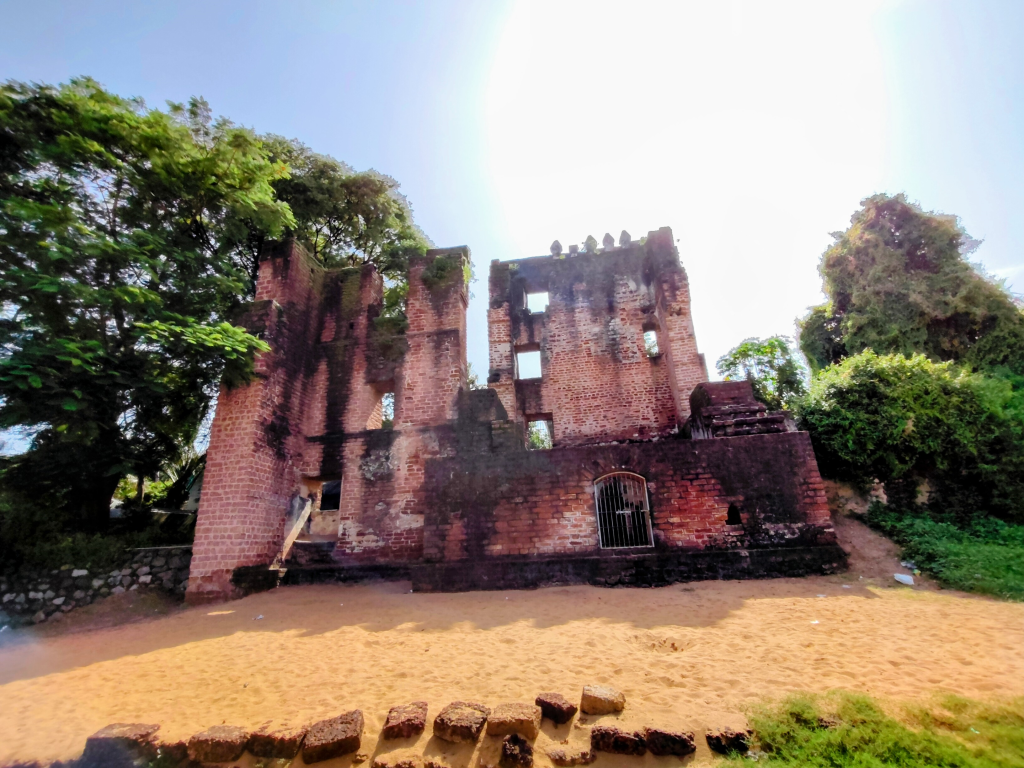
Though in ruins, the premises looked clean, and the fort was charming in its own way. The authorities had obviously put some effort into maintaining it. I was particularly happy to see the flowery bushes on the premises: the mauve-colored hibiscus and the red chethi poo (Jungle Geranium).
However, as expected, the fort was locked. There was neither any staff to guide the visitors, nor any provision to enter the building and explore it in detail. So I could only enjoy the view from outside.
In a now-archived 2007 Hindu article, I had seen complaints that mining and construction activities were rampant in the vicinity of this place. I believe the government must have put an end to the mining activities by now, but still, there were many houses around the fort.
“As per the notice, under Section 32 of the Ancient Monuments, Archaeological Sites and Remains Rules, 1959, mining and construction have been banned up to 100 metres and 200 metres beyond the protected site.
But the Thangasserry fort complex of the ASI has claim over only 5.7 cents of land. In fact, the fort wall is also the compound wall for at least two houses. Within the prescribed 300-metre periphery of the fort, there are at least 11 houses.”(Dated: 2007, The Hindu.)
But honestly, what disappointed me more was the lack of even a plaque explaining the fort’s historical significance.
Anyway, I reminded myself that India is a vast country with 4000+ forts, vying for the government’s attention, hence it’s unrealistic to be too nitpicky. So, I walked around the fort, viewing it from different angles and clicking photos.
A Game of Imagination

Whenever I stand in front of historical sites, I have this strange habit of reimagining the site from the viewpoint of a time traveller.
Imagine if I were a person who lived and died somewhere between the 1500s-1800s. What would come to my mind if I time-traveled to the present and stood in front of the St. Thomas Fort? That’s the game.
Well, I imagined the armies of the Rani of Quilon(Queen of Kollam), the Arabs, the Portuguese, the Dutch, and even the British waging wars before the St. Thomas Fort. Surreal, isn’t it?
I shook my head in protest. No, I don’t want foreign armies marching through my peaceful hometown, even in a hypothetical situation. I’m sure all the children of war will agree.
Return Journey
The cooing and fluttering of the pigeons inside the fort pulled me out of my imagination. There was also the occasional laughter from a gang of men playing cards under the shade of a tree. They were discussing “morality” (“sadhacharam” in Malayalam).
It was almost 3:30 pm by then. I realized it was time to leave, so I walked towards the nearest bus stop. The buses of nearby schools (Mount Carmel, Infant Jesus, and Trinity Lyceum) had started to ply. Many parents were rushing by in their two and four-wheelers to pick up their wards.
Many kids walked past me, too, carrying their heavy bags and water bottles. They looked tired but also relieved and happy to go home. I felt the same.
I couldn’t help but wonder, when these kids grow up, will they be happy with the systems and the kind of world we have built for them? Will they comply and surrender to the way this world runs, or will they rebel for change? Only time will tell. I personally believe we owe our kids a better and kinder world.
I waited at the nearby bus stop and soon boarded a Thangasserry-Mayyanad bus to get off at Ammachiveedu.
Reflections

As various bus stops passed by, with grand declarations that they were constructed by certain politicians, utilizing so-and-so public funds, I couldn’t help but raise my eyebrow. Everyone knows that bus stops are billboards for a politician’s future vote campaigns. Whereas, a plaque in a forgotten historical or heritage site – how much traction will it gain?
During my recent visit to the UK, I got the chance to visit the Bristol Museum. The children from a nearby school also visited the museum that day. I was pleasantly surprised to see their teacher explaining the history of each painting and relic in detail to them.
When I visited Southampton, my cousin’s wife, who was born and brought up in the UK, explained the history of their street to me. She explained how the street was famous for its strawberry farms in the past and was, in fact, named after a variety of strawberry. If she had asked me the history of the street where I now live in Kollam, I would’ve definitely had a panic attack out of sheer embarrassment.
Our lack of general knowledge and ignorance of our history make our country fertile grounds for corrupt and incompetent politicians. If India were a nation of history enthusiasts, then how would our leaders dare to rewrite our history books with lies and leave our historical monuments to neglect?
Looking Ahead
I sighed, remembering there were two more important spots in Thangasserry left on my itinerary. But I will have to park them for now and explore another part of Kollam in my next blog. It’s nice to have some unfinished business with places you love. Don’t you think? For me, it’s a good excuse to come back and to hope that things might be much better the next time.
Author’s Note:
~ All content, including images, on this blog is the intellectual property of the author. © 2025 Lirio Marchito. All rights reserved.
~ This blog is part of a series exploring my travels through my hometown, Kollam, a beautiful district in Kerala, India. You can read more posts from this series here: Kollam | Kerala | India.
~ If you are a history enthusiast, here is a detailed timeline of the St. Thomas Fort. I am only a student of literature, so please comment if you find any factual errors and provide sources to support your claims.
A Rough Timeline of St. Thomas Fort (Thangasserry Fort)
1500 – The Ruler (Rani/Queen) of Quilon (Kollam) extended an invitation to the Portuguese to establish trade. They initially hesitated due to their close ties with the Raja of Cochin.
1502 – A compromise enabled the Portuguese to establish a trading presence at Thangasserry in Quilon, marking the beginning of their role as a major pepper trading hub on the Malabar Coast.
1505 – A formal Portuguese feitoria (trading post) was set up in Quilon.
1517–1519 – Following an agreement with the local ruler (Rani), Portuguese Captain Heitor Rodrigues, acting under orders from the Portugese Governor Afonso de Albuquerque (or his successor Lopo Soares de Albergaria), began fortifying the trading post, culminating in the construction of Fortaleza de São Tomé (St. Thomas Fort) in 1519.
1658 (Late December) – The Dutch captured the fort from the Portuguese.
1659 – The Portuguese briefly regained control of the fort.
1661 – The Dutch decisively took back the fort and held it, integrating it as a strategic regional stronghold.
1741 – Marthanda Varma of Travancore defeated the Dutch at the Battle of Colachel, significantly weakening Dutch influence in the region.
1795 – Following the decline of Dutch power, the British East India Company took possession of the fort.
1823 – The British leased the fort to the Kingdom of Travancore for a term of twenty years.
Present – Today, only the ruins of St. Thomas Fort remain. The Archaeological Survey of India (ASI) manages the site, which is recognized as a protected heritage monument.
(Disclaimer: The details differ in various sources. Reference links added below: Wikipedia, Colonial Voyage, Kollam Tourism Blog, HPIP, Rotary Thangasserry, and Reddit.)
 Lirio's Wanderings