
September 11, 2025, Thursday – Day 2, Exploring East Fort in Trivandrum
After a good night’s sleep, morning walk, bath, and a light idli & coconut chutney(chammanthi) breakfast, I was raring for a long, adventurous day.
Did I mention I made new friends? Yes, of course, my three hostel roommates, who were juniors working at Technopark and native to different parts of Kerala, such as Thrissur, Kottayam, and Kollam. But I also said ‘hi’ to the tabby cat that made our hostel its home, the tiny squirrel that hopped on the fence and kept me company during my morning walk, and the part-whitish, part-light-brownish pariah dog with a black leather collar on its neck that put an end to my walk with a single growl.

Bus to East Fort
Once the morning office rush was over, I hopped on a bus to East Fort, from Attinkuzhi, the bus stop nearest to my hostel. The bus ticket cost Rs 28.
East Fort and Thampanoor are two central hubs in Trivandrum. They are just one bus stop away from each other. To catch long trains or buses, we often have to visit the Trivandrum railway station and the KSRTC bus stand in Thampanoor. Whereas East Fort hosts the central private bus stand and also the renowned Sreepadmanabhaswamy temple, nearby Puthenmalika or Kuthiramalika Palace, Methan Mani, and Margi Theatre.
Since I was seeing that bus route after six years, the familiar sights made me nostalgic, and the new sights made me realise how much Trivandrum had changed in the past years. I used this bus ride to refresh the Kazhakuttam – Bypass Road – East Fort bus route and relearn the names of all the important bus stops in between. I also jotted down the interesting sights and building names on the way so I could visit them later.
Here’s the list of bus stops and building names I jotted down: Kazhakuttam – Techno Park – Lulu Mall – Chackai – Petta – Pattoor, famous for its church – Regional Institute of Ophthalmology – State Mental Health Authority – Government Stamp Manufactory – Indian Red Cross Society – General Hospital Junction – St Joseph’s Higher Secondary School – University of Kerala – Kerala University Library – Palayam – Chandrasekharan Nair Stadium, where I once ran a 2K women’s night run with my IT friends – Palayam Church – A temple and a mosque sharing a wall – Sree Shakthi Vinayaka temple – M G Road – Statue – Government Secretariat on the left – Ayurveda college – Pazhavangadi, famous for its temple – Sreemahaganapati temple – Thampanoor – Trivandrum Railway Station – KSRTC bus station – Gandhi park – Famous textile shops like Jayalekshmi, Pothys, etc – East Fort.
Trivandrum City Bus Tour
The transport bus I boarded dropped me off at East Fort. I enquired about the city bus tour at the bus stand. KSRTC Swift’s Nagarakazhchakal ride is an open bus tour that covers the main roads and tourist spots in Thiruvananthapuram city. It runs hourly services between 3 p.m. and 10 p.m. The upper deck costs Rs 200 per seat, whereas the lower deck costs Rs 100. You can book the tickets online.
As it covers many important locations in Trivandrum, such as East Fort, Palayam, Airport Road, Shanghumugham Beach, and Lulu Mall, I would recommend it to anyone visiting Trivandrum for the first time, especially on a short trip. Since I counted myself a local and had a month at my disposal, I chose to explore the city at my own pace.
Bustling Chalai Bazaar
I walked to the nearby Chalai Bazaar. This market street has a lot of history. It is the oldest and busiest marketplace in Trivandrum.
“The narrow, crowded road starts from the East gate and ends at Killipalam. The Diwan of Travancore, “Raja” Kesava Das, established this ever-vibrant market during the closing years of the 18th century. During the rule of Karthika Thirunal Rama Varma (1758-1798 AD), Padmanabhapuram was the capital of Travancore. The king, who wanted to spend his life near the renovated Padmanabha Swamy temple, shifted the capital from Padmanabhapuram to Thiruvananthapuram. Kesava Das realised the importance of developing a market for the supply of goods in the capital city, which led to the genesis of the Chalai market.”- Chalai.org

Even on a Thursday morning, the lanes of Chalai market were bustling with activity. The small roads were congested with autorickshaws, two-wheelers, stalls on the sides, and people walking in both directions.
A few of the shopkeepers looked at me with surprise. Maybe, a woman in a purple kurta, holding onto a purple umbrella, strolling through the streets of Chalai Bazaar, with a clueless expression half-hidden by the sky-blue mask over her face, was a funny sight to them. Or maybe, my school-kid-like shoulder bag made them wonder if I was skipping school, college, or work. I wonder if anyone guessed it right: that I was skipping life, just its conventional side, though.
Meanwhile, many other shopkeepers heartily invited me to their shops. Speaking of which, like Bertie Bott’s Every Flavour Beans in Harry Potter, there were shops of all kinds in this bazaar. Shops that sold gold and silver jewellery, brass and aluminium vessels, to ones that sold bathroom fittings and plywood. Not to forget, restaurants, textile shops, shops selling kitchen utensils, gas stoves, furniture, mattresses, mats, mirrors, clocks, perfumes, mud lamps, incense pots, brass trophies, lamps, and even paintings, traditional home decor like wooden snake boat sculptures and nettipattoms– an ornament worn on the forehead of elephants during temple festivals, artistic locks called manichithrathazhu, golden trishools and silver utensils.
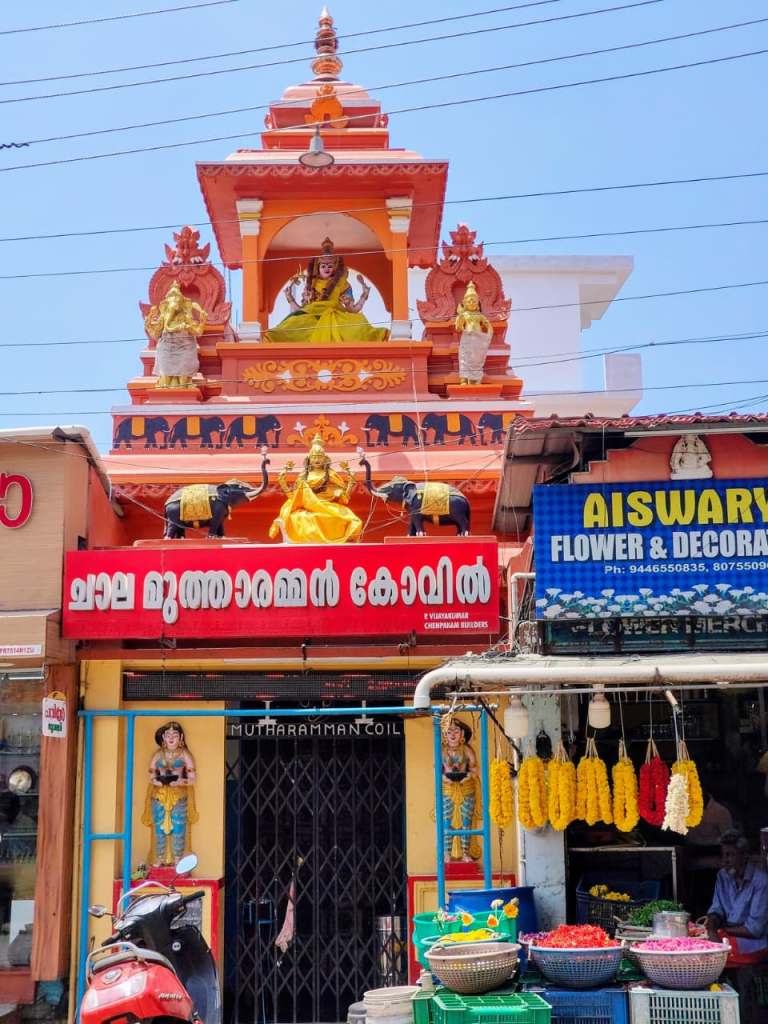
But my favourites were, of course, the stalls that sold flowers: roses, jasmines, pink oleanders, and yellow and orange chrysanthemums. I watched in awe as the seller dipped gorgeous red rose garlands in and out of a bucket full of water to keep them fresh.
There was a temple named ‘Chalai Mutharamman Kovil’ and a mosque, ‘Chalai Juma Masjid,’ in that lane. Stalls that sold flowers and incense for the pooja or temple services were also nearby. A wedding card shop named Chinthamani also caught my eye.
I walked all the way to Aryasala and returned to my starting point at the entrance of Chalai market. On my return stroll, as I reached the Mosque, I could see the renowned Sreepadmanabhaswamy temple at a distance. In a country scarred by the communal tensions between its two main religions, sights like this fill me with hope. But the hateful comments and political and religious intolerance we witness every day on social media and news make me fear for my country’s future, too.
Social media is not a good representation of reality. It’s easy to end up with hatred, jealousy, low self-esteem, racial prejudice, and religious intolerance if your only source of the real world is the lies, filtered photos, polarised opinions, and stereotypes propagated through social media. That’s why it’s so important to explore the real world, interact with real people, and listen to their life stories, not just the curated photos in their Insta grid.
Gandhi Park
Even before hopping down at the KSRTC bus stand, I had seen the Gandhi Park nearby. So soon after exploring the Chalai Bazaar, I walked through the park. There was a raised platform with a Gandhi statue. The engraving under the statue read “My life is my message. Mahatma Gandhi. Father of the nation. 1869-1948.”

Under the shade of trees, there were many benches where people sat reading their morning newspapers, making calls, waiting for a bus or train, or simply passing the time. Behind them, there were photo walls, depicting key moments from Gandhi’s life, like his birth, studies in London, protests in South Africa, Satyagrahas in India, the Dandi March, the Quit India Movement, and his assassination.
While I was photographing these walls, a few uncles and youngsters sitting on the nearby benches turned around and gazed at the walls too. I couldn’t help but smile.

Many people think fine arts is a waste of time and money. Some have said this to my face regarding my writing as well. Here’s my two cents about it. Irrespective of how my life will pan out in the future, I believe this world needs more artists and writers.
When a photographer focuses his lens on a war scene, the entire world will take notice, too. Without such witnesses, politicians could easily hide war crimes and genocides from our view. When an artist takes up a social cause, their work can create ripples in society. A good writer, driven by truth and freedom, is not only a mirror of society but also a powerful voice for human rights.
Second Breakfast
By the time I finished my stroll, my simple idli-coconut chutney breakfast had been digested. I had to call for reinforcements. So I went to a nearby small restaurant and had a big glass of Sharjah shake and an uzhunnu vada (urad dal fritters) with some coconut chutney. I badly needed it because I had so many more spots to cover that day.
To be continued…
Author’s Notes
~ All content on this blog is the intellectual property of the author. © 2025 Lirio Marchito. All rights reserved.
~ This blog is part of a series exploring my travels through Trivandrum, the capital city of my home state, Kerala, in India. You can read more posts from this series here. Trivandrum | Kerala| India
 Lirio's Wanderings
3 thoughts on “Travel Diaries: A Bus Ride to East Fort & a Walk Through Chalai Bazaar”