
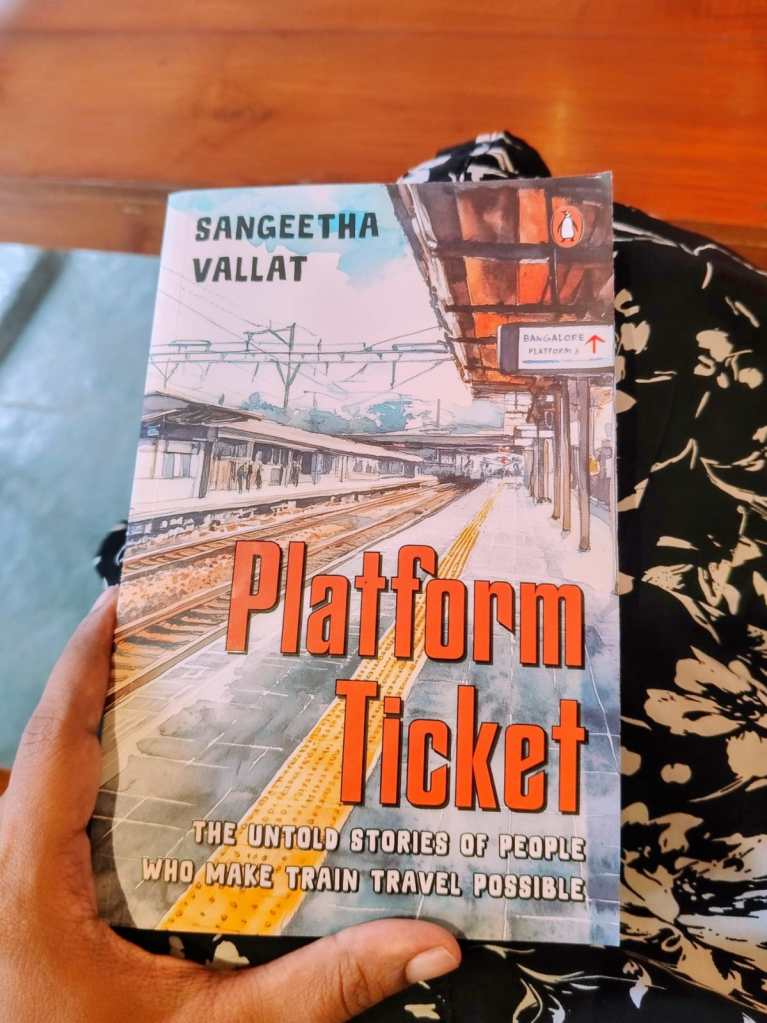
Hours before pitching her first book, The Platform Ticket, a railway memoir, at Bangalore Literature Festival’s LitMart, Sangeetha Vallath had the good fortune to run into one of her favourite authors, Shashi Tharoor. A lifelong Tharoorji fan, she sought his blessings for the pitch. When he asked her to sell the book to him with just one line, she quoted:
“As a ticketing staff, I have seen a gazillion hands – stubby, manicured, burnt, albino, with chipped nails or an extra finger, dark, fair, gnarled, wrinkled, calloused, deformed…”
One of the biggest strengths of this book, much like the above quote, is how easily and effectively it humanises and sensitises us to the lives of railway employees, especially the ticketing staff. Needless to say, the book has not only won over Mr Tharoor but also the judges at the lit fest, numerous publishing houses, and scores of readers. However, it was the Express Lady herself who charmed me first, prompting me to read her book.
An Unusual Meet and Greet
On October 17th, 2025, the first day of Kerala’s travel literature festival – Yaanam, I slipped out of the main hall of the venue, Rangam Kala Kendram, to visit the bookstore on its premises. Half-drenched in the rain, my cyan jogging shoes splattered with the red mud of Varkala cliff, the last thing I anticipated was to run into a bestselling author at the bookstore, or the author herself to start a conversation with me.
Believe Sangeetha Ma’am when she says she can start a conversation with ANYONE, because she sure did with me. A casual “So what kind of books do you read?” was enough to lure even an introvert like me into a full-blown conversation about books, favourite writers, publishing dreams, pitching, editing, and whatnot.
I enjoyed her cheerful, friendly nature, and the candid, non-judgmental conversation we had. So when she told me she had written a memoir about her railway days, naturally, I was excited to read it and grabbed a copy.
A few thoughts that ran through my head when I bought the book: “How did such a happy, candid person survive a decades-long job in railways?” “Maybe a railway staff’s life is not as mundane as everyone makes it out to be. After all, most people have no idea what their lives are like beyond the brief responses, exchange of money, or fleeting glances they catch through the glass walls of ticket counters.”
Book Review
In 1991, the Indian Railways launched a job-linked vocational course at the plus-two level in schools. They trained selected youngsters in the workings of ticketing, parcels, and goods booking, and later employed them as Commercial Clerks or Ticket Collectors. The author and her friends were part of this programme’s pilot branch.
The book follows the author’s railway life, from her twenty-year-old self, landing the job as a Commercial Clerk, to her training and employment days in various remote villages of Mysore and Chennai. However, the book neither follows a linear narrative nor is it solely about the author’s experiences.
The chapter divisions give the feel of a short story collection with an underlying theme of railway life. Along with funny, quirky, heartwarming, and at times heartbreaking stories from the author’s fourteen-year career as a railway employee, we also get to experience the lives of her batchmates, coworkers, seniors, and even the Hamals(Porters), sellers, beggars, and strangers that she encounters at various railway stations.
This means, even as we empathize with the author’s struggles navigating a new job, straight out of school, in remote railway stations, as the sole lady staff, picking up local languages, braving graveyard shifts, and at times, even dealing with dead bodies on the track… we also get to read about her batchmate Jotheeswaran(Jo)’s funny mixups with Kannada language, her niece’s naively comments on five-legged donkeys, her friend Bharti’s early morning walks guarded by a stray dog, or her friend Ilayaraja’s attempts to meet a Yaksha or Mohini under a banyan tree.
Like R.K.Narayan’s Malgudi Days or the recent delight of a movie, Laapta Ladies, ‘Platform Ticket’ also presents grounded, deeply rooted Indian imageries, places, people, and stories. The book, though written in English, cleverly incorporates dialogues in regional languages like Malayalam, Kannada, and Tamil, along with railway-speak, and uses illustrations in its storytelling.
Just like the author’s real-life persona, her writer’s voice also comes across as real, honest, and funny. So the characters and their stories easily jump off the pages and create an emotional connection with us. The book is well-paced and engaging; the chapters are crisp. So it’s an ideal choice for readers looking for a quick, yet interesting read, especially if you’re trying to get out of a reading slump.
For me, the most emotional and precious parts of this book were the author’s account of her own personal grief, the tale of three beggars she witnessed on a railway platform, and the incident in which a stranger she once sold a ticket to sheltered her in his home. The book also offered many valuable lessons on work ethics, the author’s own personal morals, and examples of how to tactically deal with people’s egos and emotions in a service sector job like railways.
I also loved that the author didn’t shy away from discussing sensitive or grey areas like brushes with corruption, crush on a senior, or incidents of harassment from strangers. Just like the railway tracks of our country, her narrative also bears witness to various natural hazards and socio-political issues that disrupted our peace, like the Cauvery water dispute, tsunami, bomb blasts, Covid-19 pandemic, floods, hurricanes, and demonetization.
Two areas where I felt the book could improve are: One, the chapter titles. Though the chapter names Platform No. 1, 2…, are apt for a railway memoir, while skimming through the book on a second or third read, these titles fail to give us any hint about the chapter’s content. I wish the author had also added a subtitle for each chapter, innovatively using railway lingo apt for the chapter theme, like entrain, detrain, tatkal, etc.
Two. This might be a personal qualm. Maybe because I met the person before the book, I felt the author withheld from talking about her personal moments in detail, like her marriage, how she balanced work-life after marriage, her personal tragedies, or the loss of her loved ones. Even the areas where they were briefly mentioned felt a bit disjointed or like an afterthought.
One could argue that the author kept the personal moments short, as this is a railway memoir. From a reader’s or editor’s point of view, I felt it created an emotional hole in the book. But as a fellow human being, I can completely understand if the writer chose to keep those moments brief for privacy or out of grief.
Or maybe we could read about it in her future book about her life in Dubai, along with her husband, after relinquishing her railway career. The author also mentioned that her second book will be the biography of a war veteran. I’m excitedly looking forward to her upcoming books.
Reviewer’s Notes
~ All quotations used in this post are from the reviewed book Platform Ticket by Sangeetha Vallat.
~ All other content on this book review is the intellectual property of the reviewer. © 2025 Lirio Marchito. All rights reserved.
~ You can read all the blogs in the Yaanam 2025 series here: Yaanam2025.
 Lirio's Wanderings