
You can read the first part of this blog here.
After wolfing down my second breakfast, I walked out of the restaurant, caressing my imaginary pumped-up muscles and roaring mentally like a war hero, fully charged for the rest of my trip. Imagine Popeye, ready to take on the entire world, after gobbling down a can of spinach, but wearing a purple kurta and sporting shoulder-length ponytail hair.
Sreepadmanabhaswamy Temple
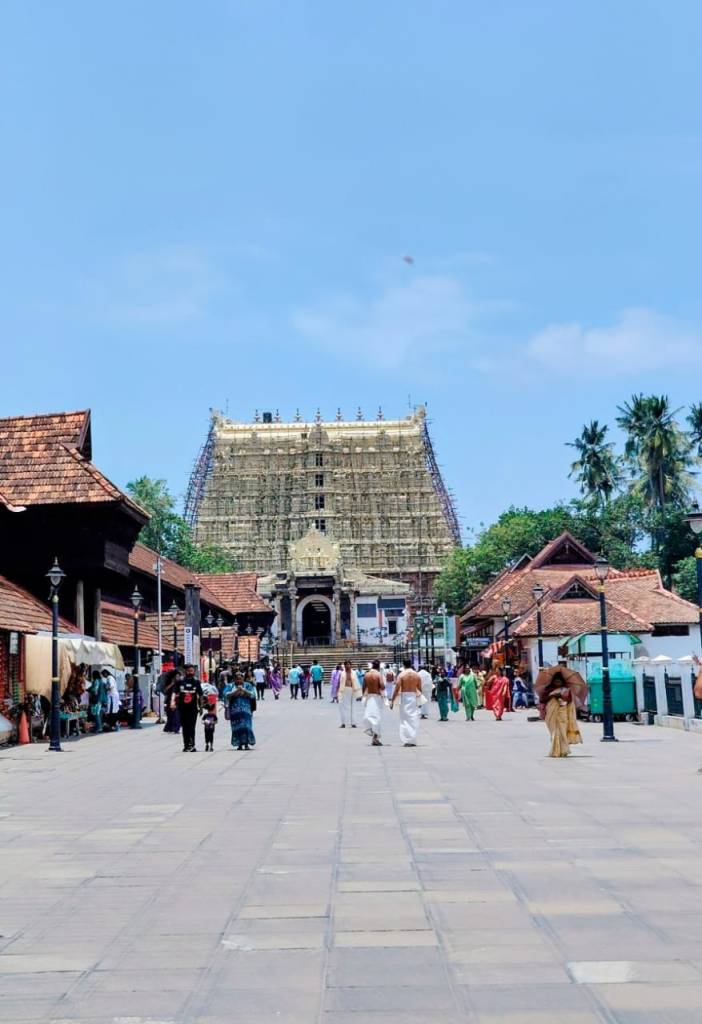
I crossed the road and walked towards the East Fort private bus stand. I could see the East Fort arch painted in white behind it, and farther back, the gold-plated gopuram of the Sreepadmanabhaswamy temple. It’s a renowned Hindu temple, dedicated to Lord Vishnu, and is considered one of his 108 holy abodes in the country. There’s a majestic statue of Lord Vishnu in anandhashayanam, resting on the coils of the cosmic serpent Ananta, in this temple.
The temple is also famous for its six underground vaults, out of which five have been opened so far, revealing an immense treasure of gold ornaments and precious gemstones. The Vault B, the largest and most mysterious vault among the six, have never been opened. It’s feared that this vault is sealed by a serpent spell, cursed, or guarded by supernatural powers. Obviously, the public doesn’t have access to these vaults.
There were police and military officers at the temple entrance. Since it was noon, I wondered if the temple was open for public darshan. I could see some VIPs being escorted inside the temple by the officers.
My friends often arrived at the temple at 5 in the morning and queued for half a day for these darshans. I had heard that the queues were notoriously long and tiresome. Unsure whether non-Hindus were allowed inside, combined with the rush and the fact that I was not dressed for the occasion, I had already made up my mind not to venture inside.

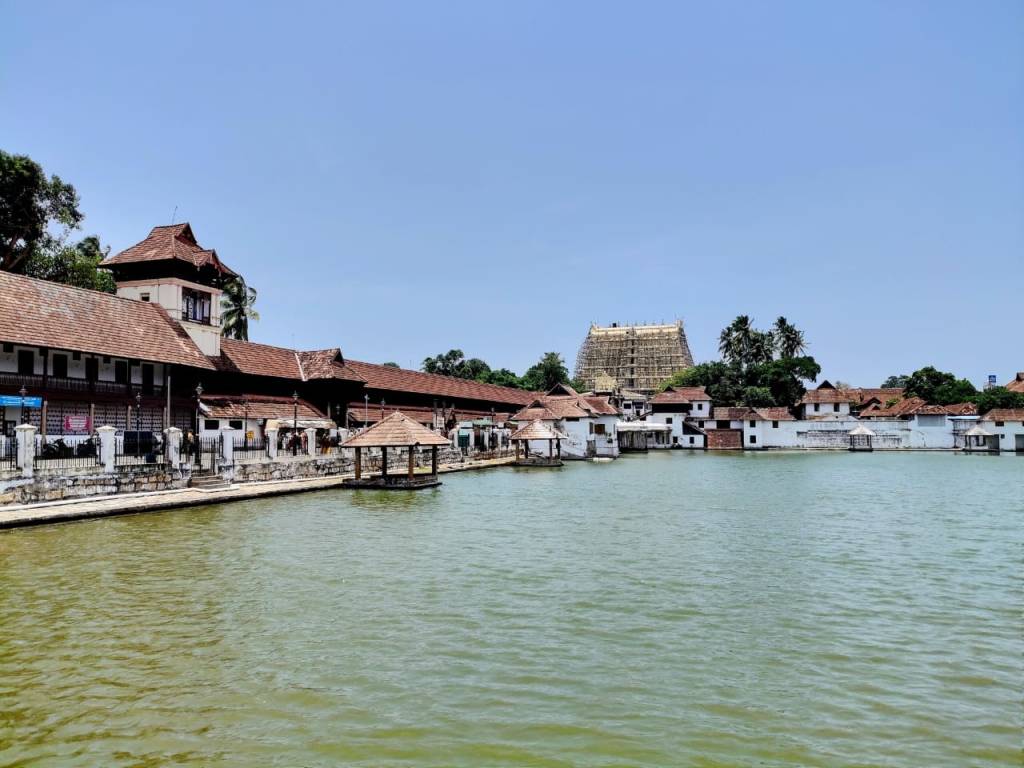
Instead, I roamed around the temple observing its gold-plated gopuram, which was covered in scaffolding that day, the large and serene temple pond with a signboard reading Padmatheertham Punyatheertham, meaning it’s a sacred pond, and a historical, mechanical clock tower in one of the buildings called Methan Mani; mani means bell in Malayalam.
Water Thoughts

Since I learned to swim(a newly acquired skill, still an amateur at it), every time I see large ponds, I wonder how liberating it would be to take a dip. The next second, my anxiety kicks in, reminding me of the pond’s depth and the suffocating feeling of water filling my nostrils.
During my swimming classes, what helped me to tide over these fears was the goggles. Wearing the goggles, I gazed underwater, staring at the bottom tiles of the pool, and reminded myself – “It’s not that deep; it’s just a pool.”
The uncertainty of not knowing enough is what makes me anxious. Experiencing the world more and facing uncertainties every day are how I’m trying to overcome my fears. My family always wants me to be in a safe and protected place. But I believe, being naive, scared, and lacking basic skills necessary to navigate this world and life is a big risk too.
Mr Han: Just tell me, Xiao Dre, why? Why do you need to go back out there so badly?
Dre Parker: Because I’m still scared. And no matter what happens, tonight, when I leave, I don’t want to be scared anymore.
As the young Jaden Smith says in the movie, The Karate Kid, I also “don’t want to be scared anymore.” I have wasted more than enough years being scared of the world and feeling not good enough to live in it. Now I’m trying to face it with courage and live it on my own terms, even if there’s a high chance I’ll make mistakes and fail in this journey.
Temple Sights

I walked around the temple and the pond, admiring its beauty. I saw shops selling khadi clothes, handloom sarees, traditional home decor, fruits, and bangles. Snack shops with rows of colourful halwas were my favourite. I also walked past an Aryavaidhyshala that sells ayurvedic medicines and potions, and smaller temples with banyan trees and serpent statues like the Sree Bala Krishna Swami temple.

From the east side of the temple, I walked all the way to the west side, soaking in the sights on the way. I didn’t know then that the Puthenmalika or Kuthiramalika palace and the Sree Uthradom Tirunal Marthanda Varma Art Gallery were just towards the left of the temple. Also, I didn’t realise that towards the temple’s western side, there was an artistic and cultural hub called Margi Theatre, which hosts free Kathakali performances a few times every month. I heard about these only many days later, so I had to revisit East Fort to check them out.
My Friend’s Experience
Many days later, when I recounted the day to one of my hostel roommates, expressing my disappointment that I couldn’t enter the Sreepadmanabhaswamy temple or see the renowned Lord Vishnu statue inside, she narrated her visits in detail.
My friend is a native of Thrissur district. Her first visit to Sreepadmanabhaswamy temple was years ago, when she came to Trivandrum to attend an exam, accompanied by her parents. At that time, they stayed at her cousin’s ISRO quarters. They visited the temple in the evening, or had an evening darshan rather than the widely preferred morning darshan.
Unbeknownst to them, it was some auspicious occasion. There were many dancers in Bharatnatyam costumes in one of the stone pavilions inside the temple, either performing or waiting for their turn. The pathways, the engravings on the stone pillars and wooden roofs, the lamp-shaped lights lit for the occasion, everything made the temple look mesmerising. Since cameras were not allowed inside the temple, my friend could only soak up the beauty with her naked eyes.
Only men wearing mundus and women wearing sarees or skirts are allowed inside the temple. Additionally, men also have to take off their shirts. Women wearing churidhars often bought a mundu from a stall outside and tied it around their waist, over their dresses, to enter the temple. Even my friend had to purchase and wear a kasavu mundu to enter.
There were two queues for the darshan: one for the general public and the other for the VIPs. Usually, these queues are notoriously crowded. However, maybe because it was an off-season(wasn’t mandala kalam) or because it was an evening darshan, there was only a moderate rush that day.
My friend and her family were standing in the regular queue. But by some lucky twist of fate, as they neared the darshan, the security staff mistook their receipt for a VIP pass and moved them to the VIP queue. Soon, they reached the front of the queue.
Usually, the black statue of Lord Vishnu, in his majestic anandhashayanam pose – reclining on the hooded serpent Anantha, with his head resting on his hand, placed inside a dark chamber, has to be seen through three doors, in the dim glow of the gold ornaments adorning his body.
But since it was an auspicious occasion, the chamber where the statue was placed was lit with lights that day. The pujaris were adorning the statue with gold ornaments, a ritual often called ‘anicharthu‘ in many parts of Kerala.
Thanks to the VIP queue and the lights, my friend had more proximity to the statue and a clearer view. Quoting her words, “We were able to see the statue of Vishnu Bhagwan with HD clarity.” She recalled that the statue looked huge and majestic, to the point that it scared her.
The first door opens to the upper portion, revealing the statue’s head, hand, and chest. The second door reveals the statue’s belly area and a lotus, on which Brahma, the creator God, is seated. And the third opens up to the leg of the statue.
When my friend peeked through the door number one, the first thing she saw was the statue’s big hand. Its size and aura scared her.
This reminded me of the scene in the Bible, Exodus 33, where Moses requests God, “Now show me your glory,” but God warns him, “You cannot see my face, for no one may see me and live.” So God offers him an alternative: “When my glory passes by, I will put you in a cleft in the rock and cover you with my hand until I have passed by. Then I will remove my hand, and you will see my back; but my face must not be seen.” It is believed that Moses trembled in awe and fear at such a fleeting sight of God, too.
Then my friend saw the statue’s face and later its legs. She recalled that the statue’s face looked so handsome and heavenly. Thanks to the well-lit room and less rush, she was able to see the statue in its grandest form, pray well, feel that divine presence, and enjoy serenity and bliss.
I’m glad that my friend was able to see the statue in all its grandeur. Because of her detailed and emotional narration, I felt I had seen the statue with my naked eyes, even though I had seen it only in my inner eyes, as painted through her words and my imagination. Coincidentally, this friend’s name means ‘the one who is dear to Lord Krishna.’ Krishna is an avatar of Lord Vishnu.
After moving to Trivandrum for work, my friend again visited the temple 3-4 times. Caught up in the overcrowded regular queues for morning darshan, pushing and shoving, sweat trickling down her brow, short of breath, she said she always mentally gave up before the darshan, even praying to end her ordeal ASAP, and often felt relieved to just be out of the queue. She could never again see the statue in all its grandeur or feel transcendence. But she hopes to experience the statue in HD clarity again someday.
Her retelling made me wonder how different a common man’s experience of India is from a VIP’s. It reminded me of a dialogue from the Jerry Maguire(1996) movie, where the heroine commented about the business class: “It used to be a better meal. Now it’s a better life.”
Heading Towards Thampanoor
After walking around the temple, from its Eastern entrance or nada, to the Western nada, I retraced my steps back to the East Fort. From there, I walked towards Thampanoor, following Google Maps.

On the way, I saw the Putharikandam Maithanam, a public ground, closed with scaffolding. Intrigued, I asked a grandpa what was happening, and to my sheer delight, he said – Circus. Earlier, when I went to the Asramam Maidan at Kollam, I saw the Gemini Circus tent, but I couldn’t visit it. So I decided to watch the show here.
As I entered the ground, I saw some labourers decorating the E.K. Nayanar Park on the side. In the middle of the ground, a huge tent of the Bombay circus was raised. There were many boards with images of clowns and gymnasts to lure the crowd in.
The ticket rates ranged from 150 to 250 to 400 to 500, depending on how close to the stage we wanted to be seated. Of course, the premium experience costs more. I chose the 250 rupee ticket, which allowed me to sit in the middle.
With a child-like enthusiasm, I entered the circus tent. Like Alice, who went down the rabbit hole, I looked at everything in wonder. The ropes holding the tent in place, the lights falling on the chairs and the stage in the middle.
To be continued…
Author’s Notes
~ All content on this blog is the intellectual property of the author. © 2025 Lirio Marchito. All rights reserved.
~ This blog is part of a series exploring my travels through Trivandrum, the capital city of my home state, Kerala, in India. You can read more posts from this series here. Trivandrum | Kerala| India
 Lirio's Wanderings
3 thoughts on “Travel Diaries: The Sreepadmanabhaswamy Temple, & Methan Mani.”