
September 12, 2025
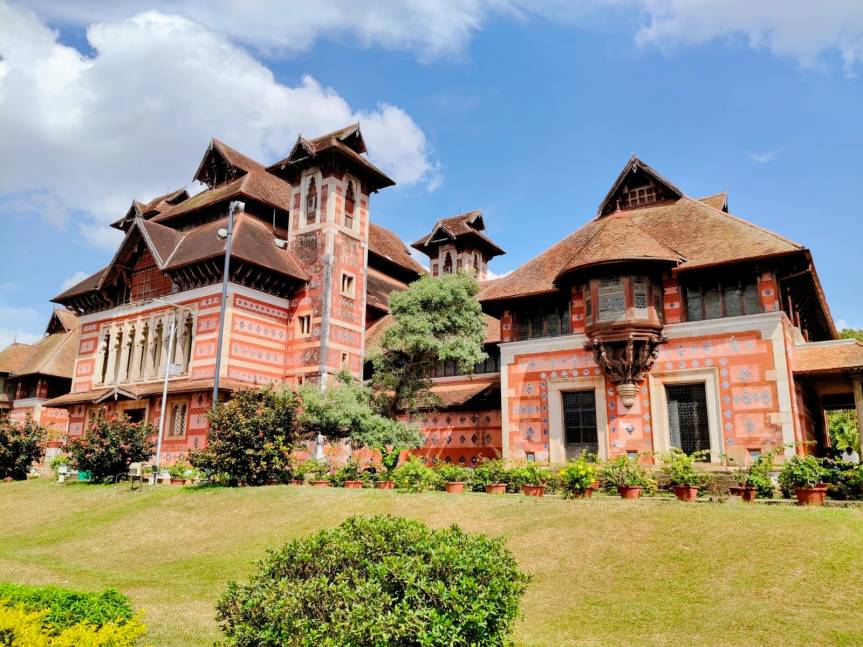
Day 3/30 at Trivandrum. Since I finished my wanderings through East Fort pretty early the previous day, I decided to shake things up a little. I changed the format of my day. Instead of starting early, I worked on my freelance project in the first half, had my lunch at the hostel, and left for my wanderings only by 1 pm.
Palayam
I forgot that direct buses run from Attinkuzhi to Palayam. I realized this only after changing buses at Kazhakoottam and laughed at my own stupidity.
On the way, close to Sreekaryam, I saw a signboard of the Vikram Sarabhai Space Centre. Though I immediately added it to my to-visit list, I couldn’t visit it this time as we have to make an appointment. Hopefully someday. 🤞
I got off at the Palayam bus stop by 2 pm. There were many intriguing sights on the way: the Connemara Market, the famous Palayam church, the College of Fine Arts, the Central State Library, the CSI Mater Memorial Church, and the Thiruvananthapuram Municipal Corporation. Not to forget the heartwarming sight of the Sree Shakthi Vinayaka temple, Haji Ali restaurant, and a mosque sharing compound walls. But I was determined to explore the Napier Museum first, as it closed by 4 pm. Google Maps showed that it was barely a 1.7-kilometre distance, a 4-minute walk to the museum.
The Garden
In a few minutes, I reached the entrance of the 55-acre campus where the Napier Museum is situated. This campus also has a Zoological Garden, Natural History Museum, Art Gallery, Sri Chithra Enclave, KCS Panicker Gallery, Aquarium, and 3D Theatre.
As soon as I entered the entrance gate, the ambience around me changed. The air was fresher and more moist. I needed a moment to catch my breath, so I sat on a dark-green painted bench and looked around.
Even though it was a weekday and an odd hour, around 2:30 pm, there were many visitors on the premises, especially youngsters. Friend gangs, couples, families… Two staff ladies in khaki uniform – a salwar and a khaki overcoat on top – were watering the plants in the garden.
The plants looked stellar, especially the flowering ones like red and pink Chethi poo(Ixora), yellow and orange Jamanthis(Chrysanthemum), yellow and white daisies, and purple, pink, and white Bougainvilleas. There were so many more, whose names I don’t know. I saw a blue fountain in the middle of the garden, though there was no water in it.
I felt the government’s recent renovations were artistically done. I could see a lot of good improvements since 2019, the last time I visited the museum (Remember my first failed attempt at an India trip in 2019? Yes, as part of it).
The Napier Museum
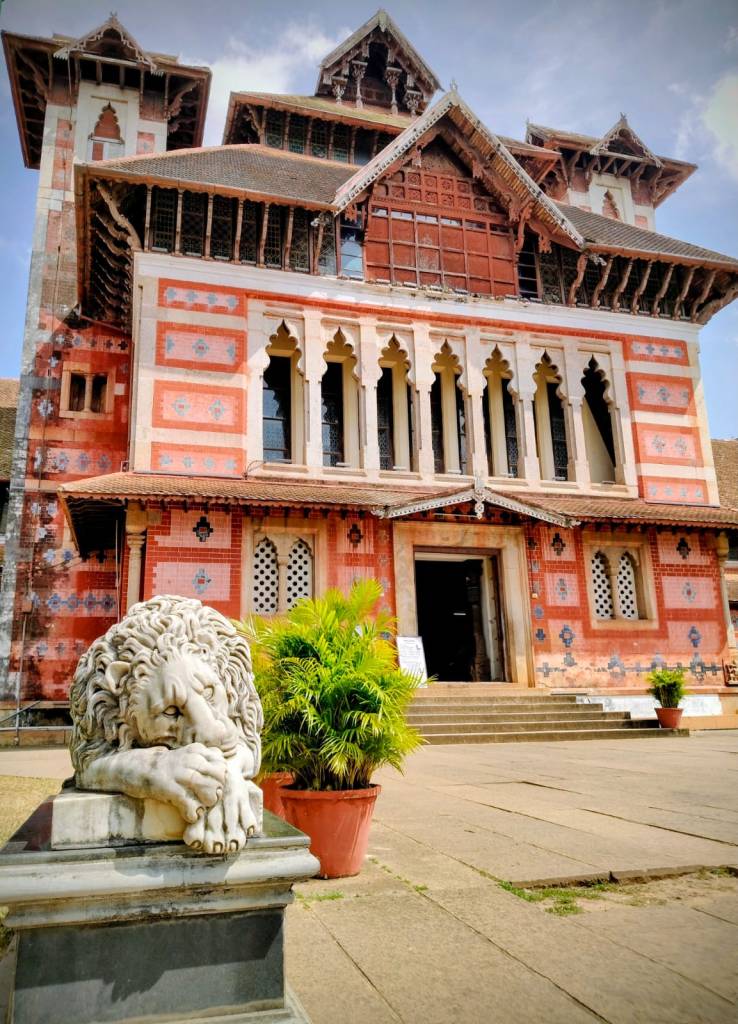
The sleeping lion statues located at the front of the Napier Museum greeted me like old friends. “Still here?” I wanted to ask. “Still gallivanting?” they might have mocked in response. I find them adorable. Only while researching for this blog, I learned that these statues are copies of the renowned Italian sculptor Antonio Canova’s marble sculptures – Canova lions.
In the past, I only had to pay one entrance fee to see all the buildings inside this campus. Now I have to buy separate entrance tickets at each building.
I bought a Rs 30 ticket to see the Napier Art Museum. Photography was free, but videography cost an extra Rs 2000. Free photography was more than enough for my shoestring budget.
As usual, I chatted with the ladies at the ticket counter and the security staff at the door before entering the building. Their tips and recommendations often help us pay attention to the intricate details a naive eye would otherwise miss.
Ancient Statues
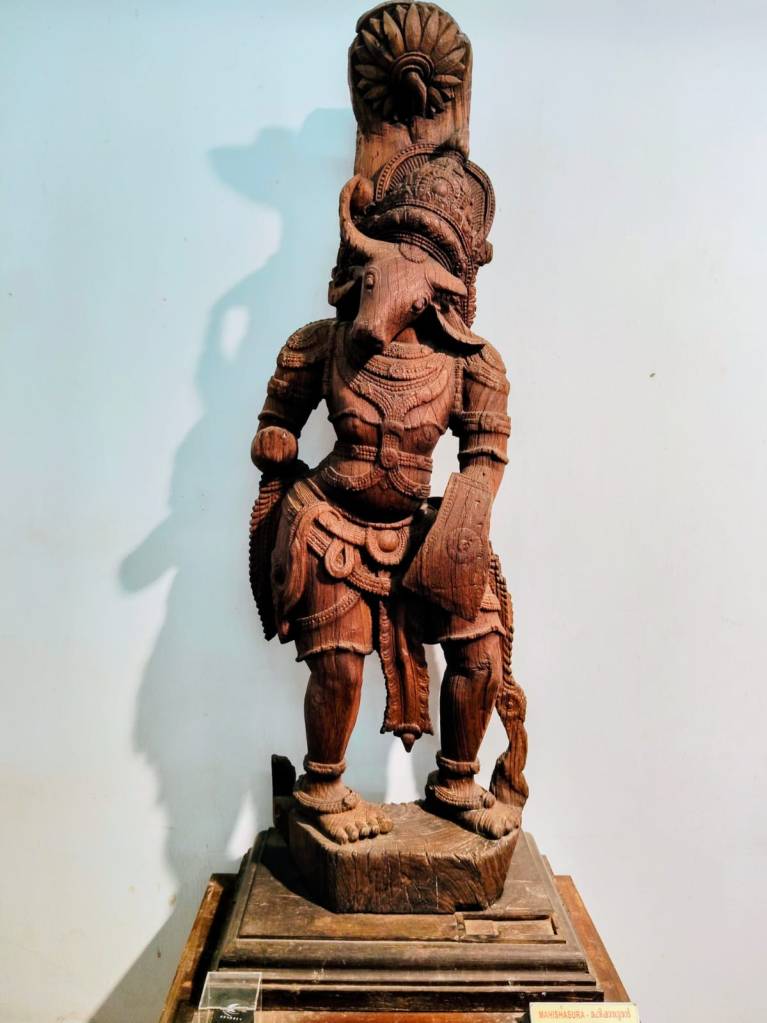
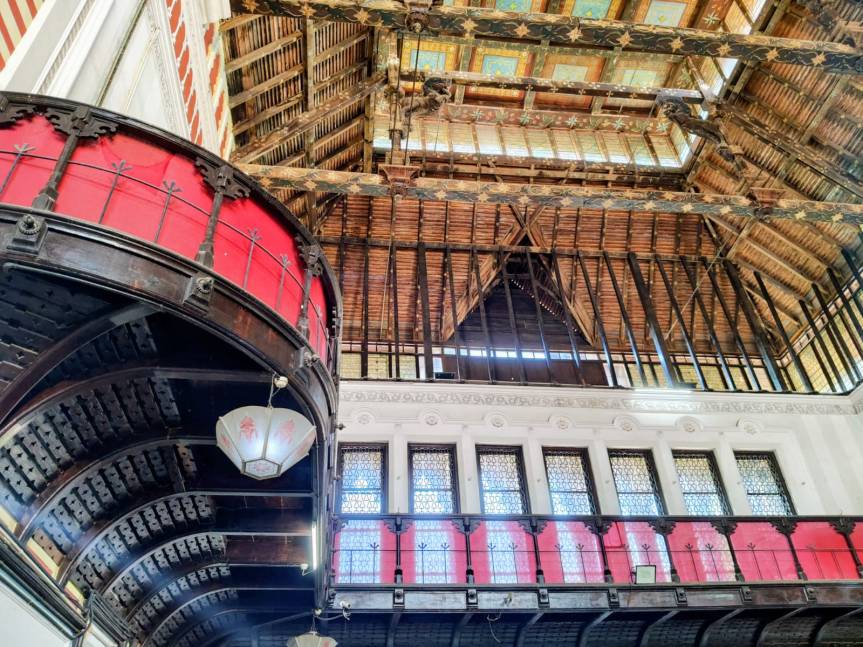
Inside the building, I was greeted by the nostalgic white walls, wooden ceilings, and statues in glass boxes. If you explore South Indian history, you will come across many enduring empires like the Cheras, the Cholas, and the Pandyas in the Sangam Period, the Pallavas during the medieval period, and the Vijayanagara Empire in the later periods.
Even though I had forgotten most of the history I learned at school, my face lit up in delight when I saw statues of Hindu Gods like Lord Vishnu, Brahma, Indra, Rama, and Hanuman from the Pallava and Chola ages in the first row. I noticed that most of these statues were excavated from Kulathupuzha, a town in the eastern part of my home district, Kollam, and Thiruvattar, a panchayat town in Kanyakumari, Tamil Nadu.
There were also many statues from the Chera and Vijayanagara kingdoms. Most of these statues were handcrafted from a single piece of wood. There were also statues carved or molded from stone, ivory, and bronze.
Varikkaplavu
I learnt from the museum staff that the wood of the Varikkaplavu (Jackfruit) tree was extensively used to carve the wooden statues. I wondered out loud why the Jackfruit tree’s wood was preferred over the contemporary favorites like teak or mahogany.
Apparently, the Jackfruit tree has been used for temple carvings, idols, and musical instruments since time immemorial. This wood is naturally termite-resistant and more durable than teak. Its rich, golden-yellow color deepens over time, giving it an elegant look. Besides, its fine-grain texture makes it ideal for carving delicate facial features and intricate clothing on figurines.
Napier Museum App
Later, one of the museum staff, who patiently answered all my queries, suggested I download the Napier Museum App from the Play Store and listen to the audio notes by scanning the QR codes in front of each statue.
I loved listening to these descriptions. I also made a mental note to go home and read more about these Hindu figures, like Mahishasura Mardhini (Goddess Durga depicted in the act of slaying Asura Mahishasura), Nataraja (Lord Shiva depicted as performing Tandava – his cosmic dance of creation, preservation, and destruction), Ardhanareeshwaran (a composite, androgynous form of Lord Shiva and his consort Parvati), Uma (another name for Goddess Parvati), and Sati (Lord Shiva’s first wife).
Apart from the statues of Hindu Gods, there were also statues of devi(goddess), devotees, kings like Sree Chithira Thirunal Balaramamvarma (the last ruling Maharaja of the Princely State of Travancore), and even figures from other religions like Bodhisattva, Buddha, and Jesus Christ.
Southeast Asian Gallery
After exploring the statues from the Sangam period and later the Gandhara and Pala kingdoms, I reached the Southeast Asian gallery. Head dresses of Balinese Janger dancers and priests stared at me from the shelves. If Balinese visitors ever walked into this museum, they might be surprised. The walls display photos of the Sun Temple, Prambanan in Java, and Balinese costumes… all because Maharaja Balaramavarma was an avid collector of Balinese art.
Aura
There were also many pieces moved from the Sree Padmanabhaswami temple. Some of the statues in this collection were full of aura; it made me feel they had some divine spirit trapped in them. Maybe it was just the sculptor’s insane skills. Or was it their creative energy reverberating from the statues? D P Roy Choudhary’s Lord Shiva statue with an open third eye was one such instance for me. It gave me goosebumps and scared me a bit, too. The Shasthavu and Garuda statues also evoked a feeling of both awe and eeriness in me.
Women Figurines
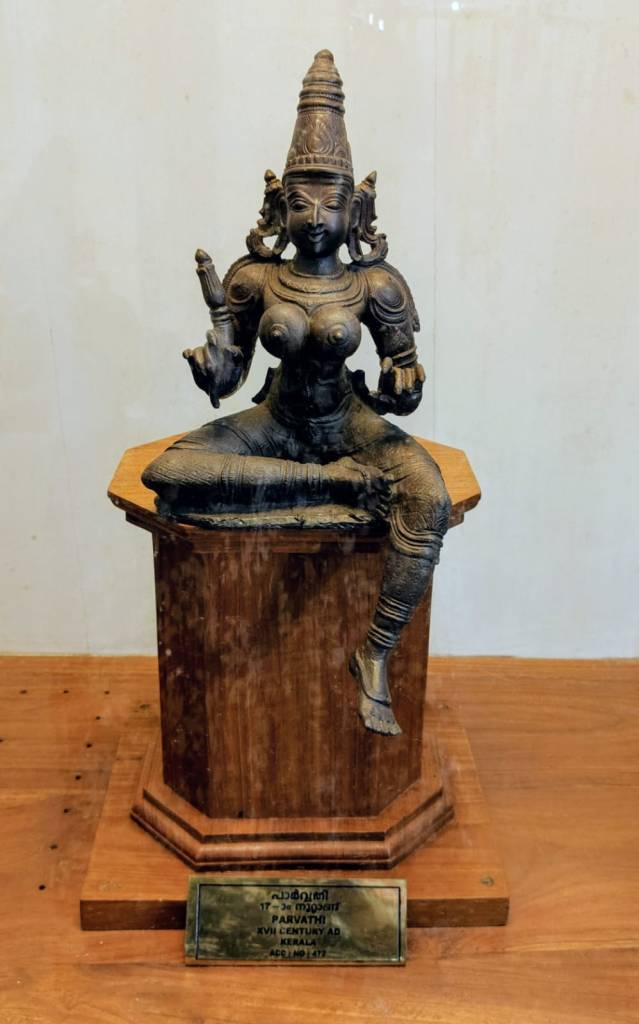
I also particularly enjoyed admiring the women figurines in the collection. They weren’t just elegant but powerful. They weren’t portrayed as meek or submissive, but as majestic. They wielded power, and sometimes even weapons. These ancient statues made me realise women weren’t always perceived as weak or in need of protection; patriarchy or misogyny was learned or deliberately conditioned. So were all the fears and worries I carry associated with my womanhood.
Up next, rows of musical instruments, traditional lamps, aranmula mirrors, jewellery, coins from different periods of the British Raj and the Princely states in India, wooden chariots, Japanese and Ceylonese (Sri Lankan) masks, and porcelain utensils used in China during the Ming and Sung dynasties piqued my interest. Once I had reached the end of the museum, I wondered why it was just one floor. I would’ve loved to see more and more archaeological stuff like this.
Reflections
By 3:45 pm, I thanked the staff who helped me and came out of the museum. I sat on one of the benches in the garden, jotting down all the points I could remember about the museum. I knew by then I must’ve forgotten at least 95% of the facts and images I had read or learned inside. But it didn’t matter.
The only thing that mattered was all the emotions that filled my heart and the thoughts that flooded my mind… when I stood in front of those artworks and statues, admiring their excellent craftsmanship and feeling the artists’ spirit in them. That was the highest ‘high’ of this visit. Those statues spoke to me in a language the artist wanted me to hear. Some of the statues made me feel pain, anger, joy, bliss, and even majesty. No, neither my blog nor my photos or videos could capture its full essence. As the professor in the Hachiko movie says, there’s a part of life that can never be captured.
I might be misquoting it for the umpteenth time, but here goes the original:
- Parker Wilson: I’m a lot older than you, but I tend to think that there’s an element of music that cannot be captured. Life cannot be captured. (The) Human heart cannot be captured. The moment of creation itself is fleeting.
That’s why it’s so important to show up to these places in real and see these sights with our naked eyes and experience them with an open, sentient heart. Life is not meant to be captured or conquered or endured, but lived intentionally… with lots of love, passion, admiration, grace, and gratitude.
Mom-mode
Once I had finished jotting down my notes and collecting my thoughts, I kept my phone aside and just admired the beautiful garden around me. It looked so much more alluring than on my last visit. Whoever redesigned it did an excellent job. They’ve added many new photo points, but what really stole my heart was the wide variety of plants in the garden. It even activated the Mom-mode in me; I wanted to ask for a seed or branch of each plant. Had they opened a nursery, I would’ve spent a considerable amount of my travel budget there.
Just then, I saw the Sreechithra Enclave at a distance. According to the staff I talked to, it hosted many original paintings, depicting many historical moments from Kerala. I was curious to explore it and learn more about my state – its history, culture, and people.
To be continued…
Author’s Notes
~ All content on this blog is the intellectual property of the author. © 2026 Lirio Marchito. All rights reserved.
~ This blog is part of a series exploring my travels through Trivandrum, the capital city of my home state, Kerala, in India. You can read more posts from this series here. Trivandrum | Kerala| India
 Lirio's Wanderings