
September 12, 2025
Sree Chithra Enclave
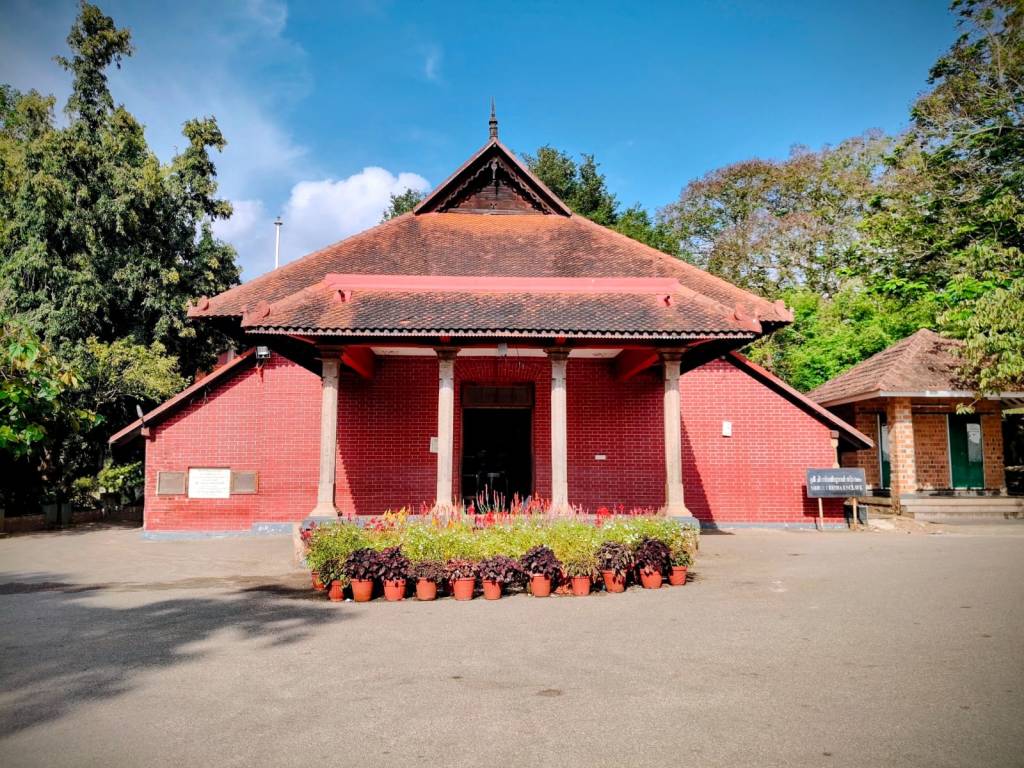
I could see the Sree Chithra Enclave at a distance. I ogled at its red-brick building with sloping roofs and the neatly arranged rows of flower pots in front of it. Luckily, the Napier Museum entrance ticket also covered the enclave, so I didn’t have to purchase another ticket.
I had to take off my shoes at the entrance as the building has wooden flooring. I loved walking around that space in my socks. I enjoyed the lighting and the calm ambience inside the building, too. I wish the Napier Museum also used the same settings; it definitely needs better lighting.
History
Let’s explore the history of this museum first. The Sree Chithra Enclave was developed as a personalia museum, or biographical museum, dedicated to the memory of the last Maharaja of the Travancore dynasty, Sree Chithira Thirunal Balarama Varma (1912-1991), a passionate lover of arts and literature. It was inaugurated on November 12, 1993, two years after the Maharaj’s death, and was opened to the public on 4th July 2007.
Sree Chithira Thirunal Balarama Varma
As soon as I entered the building, I was cordially welcomed by the majestic portraits and statues of the late king. Sree Chithira Thirunal Balarama Varma reminded me of that artistic friend all of us had at college, with whom we could stay up all night, talking about books, history, politics, travel, cinema, and art, and watch the sunrise together the next morning.
No disrespect, but in the new-gen slang, he seemed like a chill dude. Maybe he and I could’ve hit it off as friends if I were born 80 years before, and not discriminated on the basis of my caste or gender. It’s a highly unlikely ‘if,’ I know. I would love it if a science fiction enthusiast from Kerala wrote a novel with that plot. I will definitely queue up and buy a signed copy of that book.
The museum hosted the king’s belongings, his pencil drawings, the golden chariot used by him and Amma Maharani Sethu Parvathibhai, and artefacts from the Travancore dynasty, like medals, stamps, coins, service cards, and envelopes.
Mural Paintings
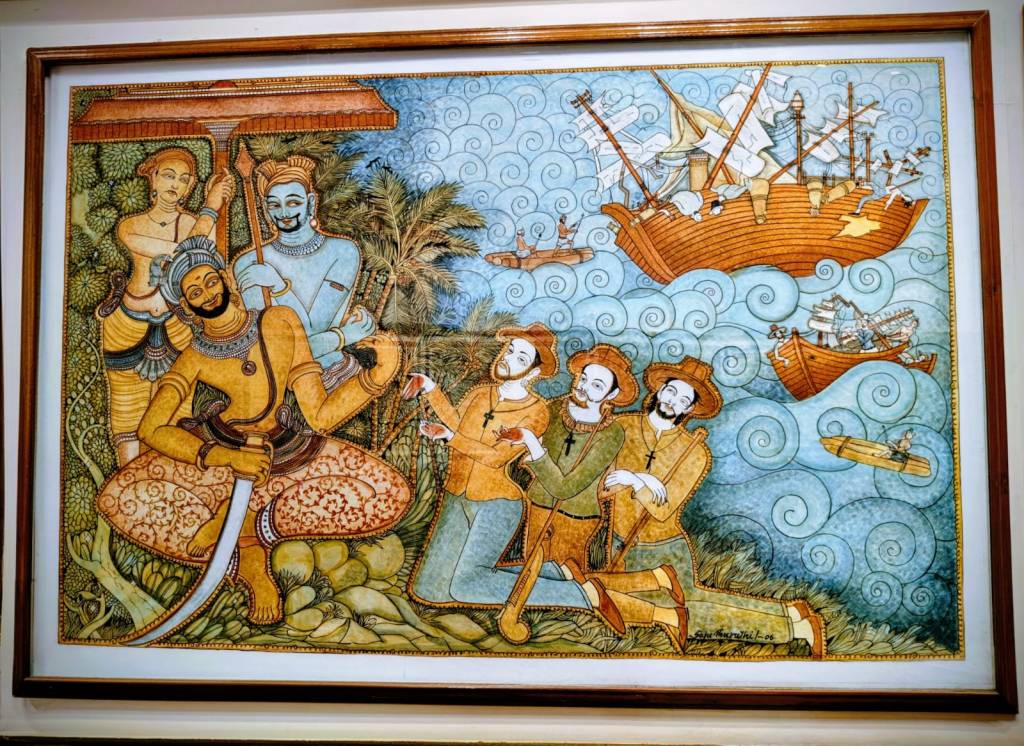
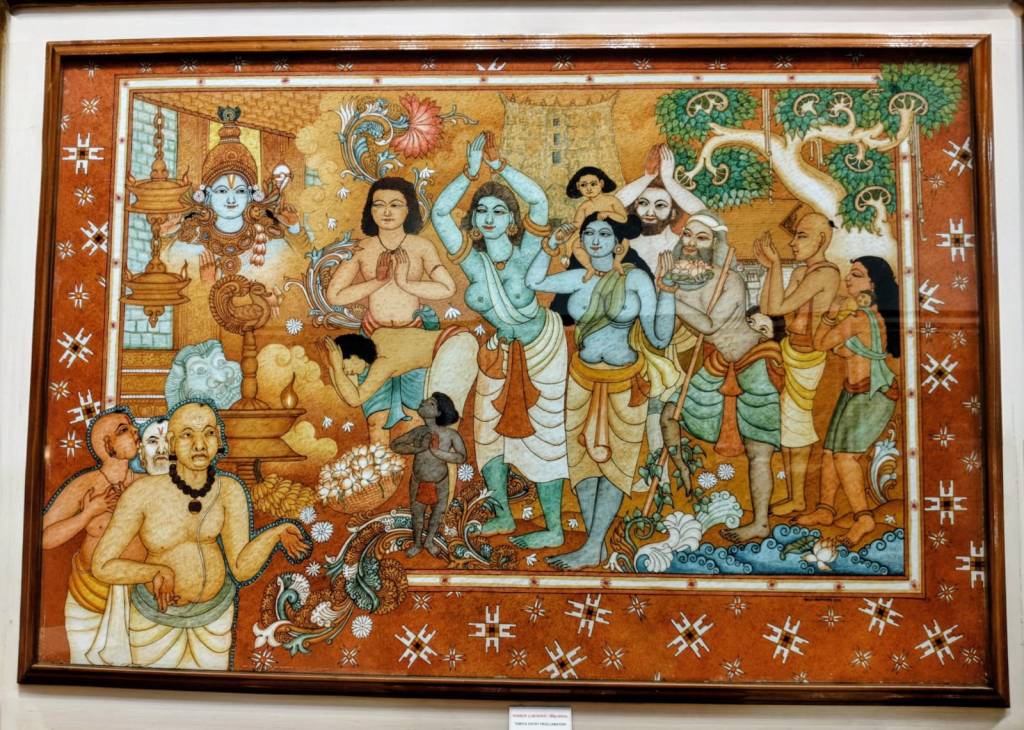
But my favorite part of the museum was the mural paintings. I loved all 14 of them. They depicted key moments in Kerala’s history during the Travancore Dynasty’s reign. This included the Painkini Festival (the royal festival of the Travancore Dynasty), the Kundara Proclamation – the historic call to arms issued by Velu Thampi Dalawa on January 11, 1809, at Kundara, Kollam, urging people to rise against the British colonial rule and the East India company, and the Colachel battle in 1741 that nipped in the bud the Dutch dream of supremacy of Travancore.
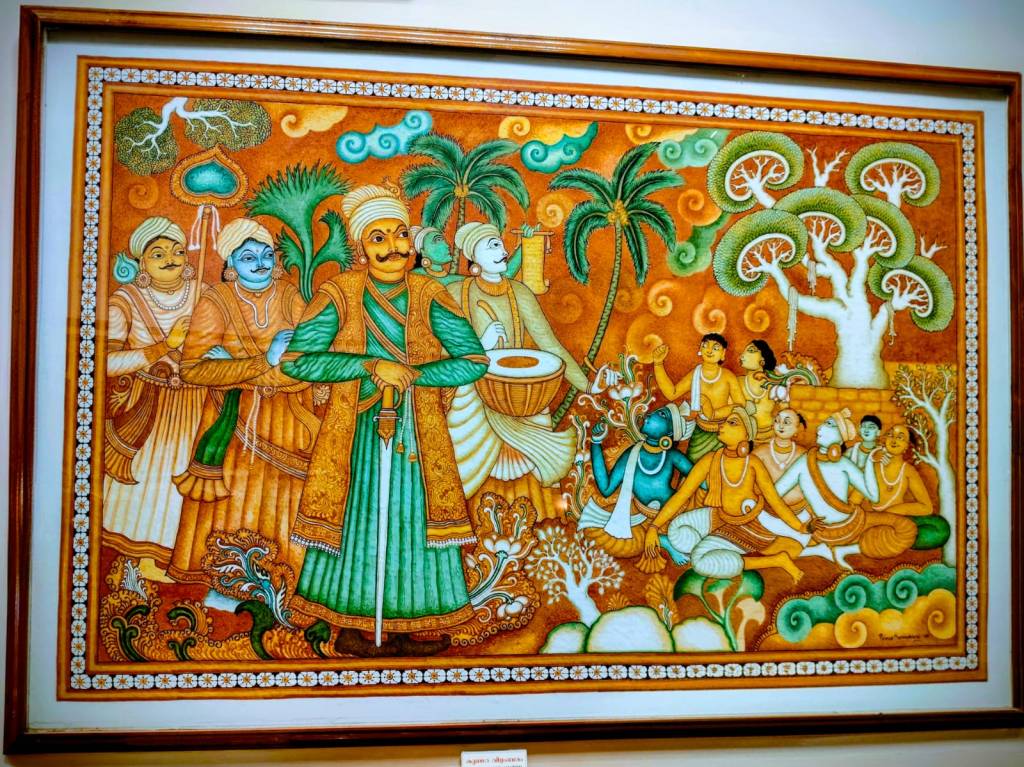
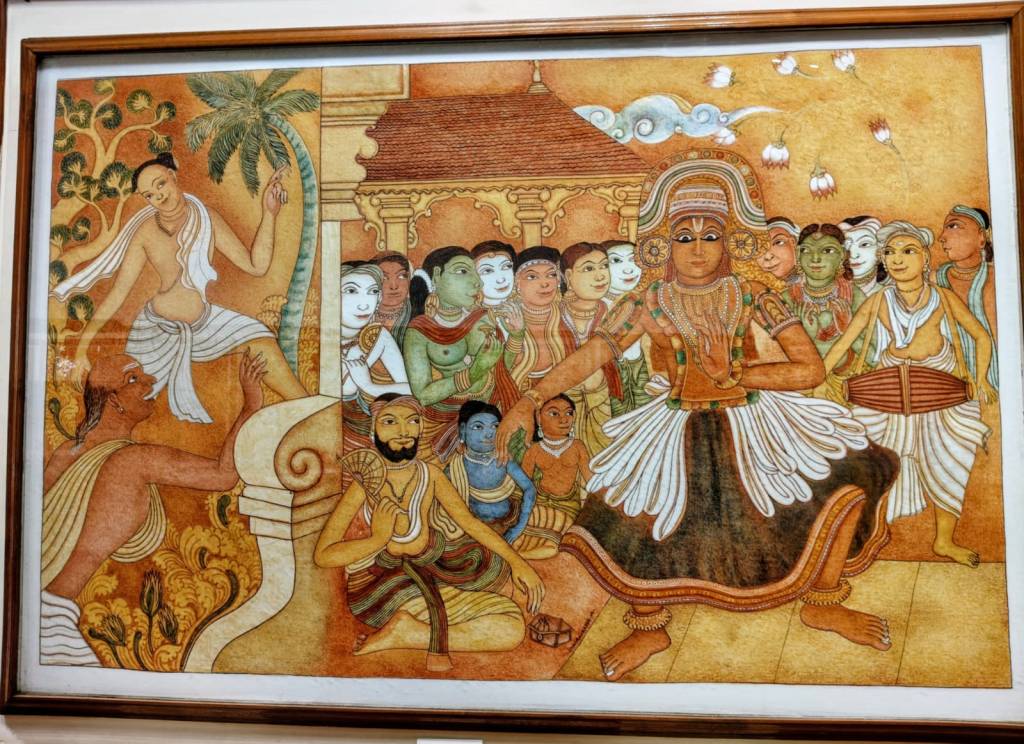
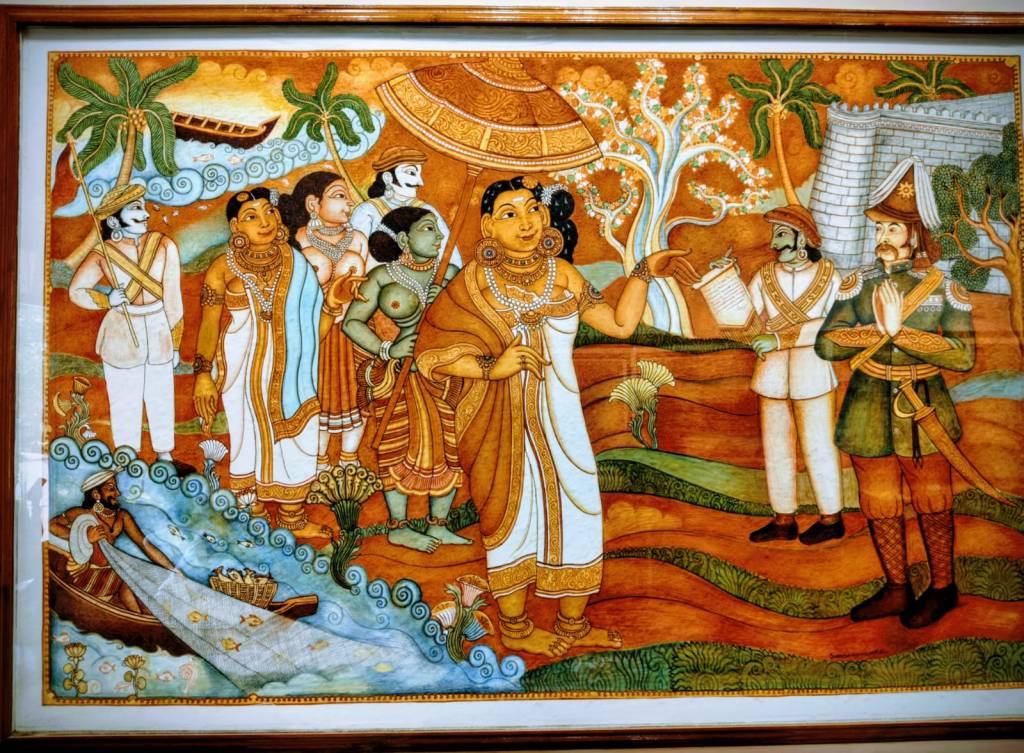
The paintings also portrayed lighthearted moments like an Ottan Thullal performance, the royal queen visiting the Anjengo fort, and many more. Loved the eyemakeup of the Thullal dancer. Lakme should use an Ottan Thullal performer to sell their iconic kajal.
Temple Entry Proclamation
My favorite painting was the one about the temple entry proclamation. Untouchability was an obnoxious social evil in Kerala that discriminated against the people of lower castes. Public roads, public wells, and temples were out of bounds for them. In 1936, in a highly progressive move for the time, Sree Chithira Thirunal Balarama Varma issued the temple entry proclamation, which permitted Dalits to enter temples.
Maru Marakkal Samaram
The Anjengo painting was also intriguing. If you observe it closely, you will notice that in the past, only upper-caste women were allowed to cover their breasts. This led to the Maru Marakkal Samaram by lower caste women for the right to wear upper-body clothes, covering their breasts. History reminds us of all those big changes we take for granted in our daily lives.
People Watching
I finished exploring the enclave by 4:15 pm. There wasn’t enough time to explore the nearby Natural History Museum, children’s park, zoo, or the art exhibition in the nearby hall. So instead I went to the museum canteen and had a tea, and two fritters – a parippuvada and an uzhunnuvada. One thing I can vouch for as a travel enthusiast is that you will almost always be hungry, so eat well.
Later, I strolled through the garden, admiring the trees and the flowering plants. I didn’t know their names, but they looked lovely. So did the young ladies in kasavu sarees who were busy immortalizing the day through photographs. Since it was already evening, many youngsters and retirees turned up to exercise. Many families and office-goers came to unwind after a busy day at work.
Slowly, I walked off the campus. The waterlogged entrance of the museum complex irked me. I wondered why no one was doing anything to fix it. Suddenly, my mind juxtaposed an alternate thought – maybe you are that someone.
Theruvukal Nee
I saw the Sree Narayana Guru Park opposite the museum, and also the nearby museum police station. There were many stalls just outside the museum selling pani puri, popcorn, cut mangoes, toys, and even flutes.
One of the stall owners told me I should walk to the PMG junction to get a direct bus to Kazhakoottam. It was a 1.1-kilometer, 15-minute walk on a mostly flat road. I accepted the challenge and traversed the path, the Malayalam film song ‘Theruvukal Nee, Njan Vegamaayi’ running in a loop inside my head. Maybe because the song was shot in Trivandrum.
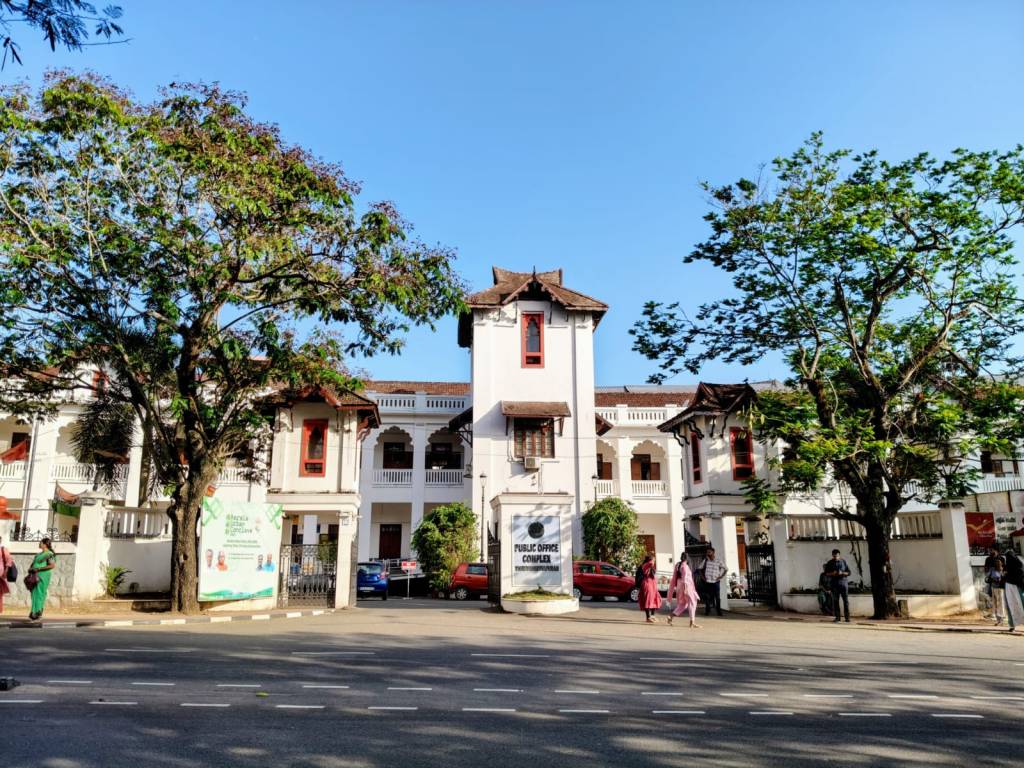
A passing bus to Kulathupuzha, the archaeological excavation site, piqued my interest. There were also many government buildings on that route: Public Office Complex, including the Office of the Commissioner of Land Revenue, Kerala Water Authority, Kerala Disaster Management Authority, the Thiruvananthapuram District Football Association, and also cultural buildings like Kerala Cultural Forum Sathyan Smarakam, C Achuytha Menon Park, and Captain Lakshmi Park.
Special City Bus
750 meters away from my destination, I saw an office workers’ special city bus that goes to Lulu Mall, Techno Park, and Kazhakoottam. It would take me directly to Attinkuzhi. I thanked God in my mind. I couldn’t believe my luck. I reconfirmed the route with the driver and the conductor, who was a lady, before getting in. They said there were no other buses on that route that would take me directly to the Techno Park side and asked me to get in right away. I promptly obeyed.
Immigrant Labourers
As we waited for more passengers to pour in, I overheard a conversation between the driver and the conductor. The lady noted that immigrant labourers from other states were now the most frequent passengers on KSRTC buses. Thanks to these workers, KSRTC buses collected a decent fare every day. Places like Sreekaryam, Kazhakoottum, and Chanthavila hosted a lot of immigrant labourers. But their hub, of course, was Perumbavoor in Ernakulam – she mentioned that it has become their area now. I wondered why she was speaking in a complaining voice. If we go to a farmland or a construction site in Kerala, I bet 100% of the labourers will be immigrants from other states.
I could hear the typical Trivandrum slang in their conversations – words like entharu and woh. It reminded me of a few lady friends I made during my IT days, who worked in stores and restaurants near Techno Park. Sometimes, it was difficult to follow their conversations.
City Sights
By five, the bus started from the museum stop. I bought a Rs 33 ticket to Attinkuzhi. On the way, I saw the Manaveeyam Road, which I have heard a lot about. A lot of cultural activities happen there, and many amazing food trucks park there, too. People love hanging out there in the evenings and at night for leisure.
Many other interesting buildings whooshed past me: Kerala Police Headquarters, Forest Headquarters, Kalabhavan, Government College for Women, Russian House, Lady of Fathima Church, Hilton Hotel, and Nabard. Many office goers kept entering and exiting the bus. The dry leaf collector machines on the streets made me curious. Meanwhile, the yellow evening glow of Trivandrum city gave a vintage charm to my view.
Nostalgia
Places like Vazhuthacaud filled me with nostalgia. I used to attend Politics and Geography classes there, every weekend for about 8 months, along with my IT job, hoping to succeed in various government exams. But I gave up after the first trial and failure. Just one among many things I tried and gave up after a while.
Then the bus turned onto MG Road, revealing buildings such as the Office of the Principal Account General, South Park Hotel, University College, Ayankalli Hall, and the St. Mary Queen of Peace Basilica. The church jogged my memory because I had prayed there before. Probably sometime in the past, when I visited the nearby Zam Zam restaurant. More government buildings entered and exited my frame: the Legislators’ Hostel, A K G Padana Gaveshana Kendram, Directorate of Health Services, and later the General Hospital.
Seeing the Hospital, I realised the bus was travelling through the Medical College route. I wondered where the turn to the Techno Park was. Moving past the Kerala State AIDS Control Society building and the Regional Institute of Ophthalmology, the bus reached Pattoor, famous for its church.
Many signboards on the way announced that an Onam Expo was still happening at the Lulu Mall. I felt Trivandrum was one of those happening cities in Kerala, though much behind Kochi, of course. On the way, a big apartment complex, with a garden only on one balcony, amused me. Why didn’t any other occupants plant a garden? I wondered.
At Pettah, the smell of grilled chicken evoked the images of hot shawarma dipped in mayonnaise in my head. “You’re on a budget trip. You’re on a budget trip,” I kept mumbling to myself. Riding past Kanjiravilakam Devi Temple, Chackai roundabout, Lulu Mall, my old IT office at Kuzhivila, the bus reached Attinkuzhi by 6:15 pm.
A Scary Sight
Back in my hostel, I freshened up and went to the terrace to call my family. But before I could call or inform them about my whereabouts, the sight in front of me scared me. Multiple hills and slopes were being scraped down by JCBs to clear the land for construction.
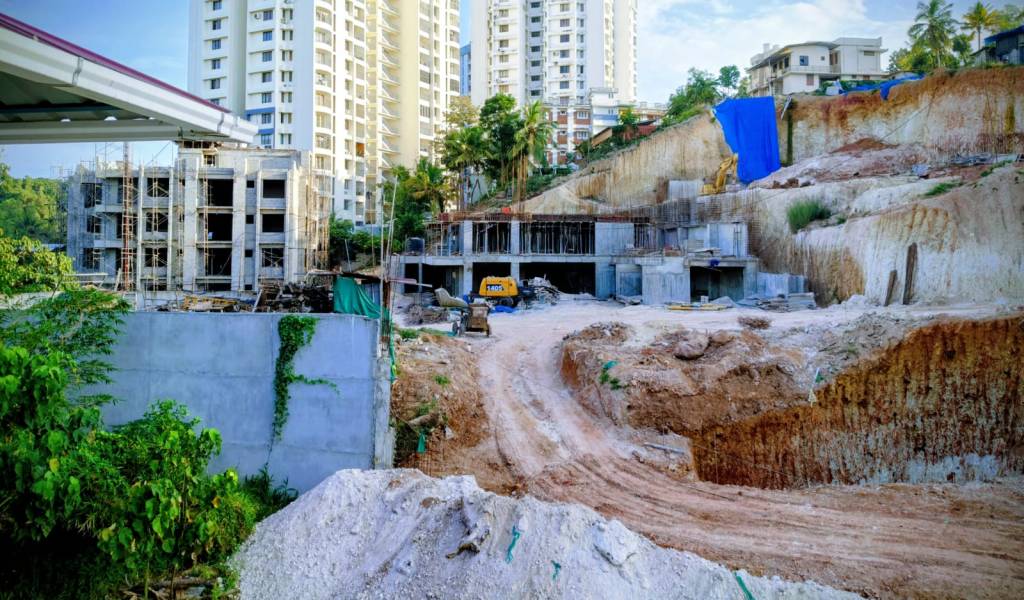
According to one of my hostelmates, who worked as a civil engineer at the construction site, eleven apartments and multiple other buildings would soon mushroom in that space. Will the scrapped hill lands hold in the next monsoons and floods? The heartbreaking visuals from the 2024 Wayanad landslides flooded my mind. I didn’t dare to answer no.
Author’s Notes
~ All content on this blog is the intellectual property of the author. © 2026 Lirio Marchito. All rights reserved.
~ This blog is part of a series exploring my travels through Trivandrum, the capital city of my home state, Kerala, in India. You can read more posts from this series here. Trivandrum | Kerala| India
 Lirio's Wanderings