
The gap between what’s promised online and the on-ground reality .
Disclaimer
- Please read the first part of this blog here to understand the full context.
9 May 2025 – My Second Trip
I listened to the latest news about the shelling and aerial attacks at the India-Pakistan bordering states. With Pakistani troops resorting to numerous ceasefire violations along the Line of Control in Jammu and Kashmir and western borders of India last night, India repulsed their attacks at first, then retaliated, and things have escalated on both sides. The news of another Nipah outbreak in Malappuram district also raised concern.
I got ready for another visit to the Sardar Vallabhbhai Patel Museum. This time, I didn’t take my shortcut. I boarded a bus to Kacheri, then took an Iravipuram bus, and got off at the Kollam railway station stop. I walked to the spot where I saw the police museum board last time. It was around 11:50 am, and the gates were still locked.
In the nearby shop built for disabled people, I found a frail, shirtless man resting. I asked him about the museum. He confirmed that the museum was not functional at the moment. But he went on to correct the main mistake I had been making.
What I had been looking at was only the side gate to the museum, next to the Sree Puthiyakavu Bhagavathy Temple. To find the main entrance, I had to go back to the NH’s side, take a left, and walk a bit. The police museum is located inside the compound of the East Police Station, Kollam.
So, I thanked him and hurried to the location. I was a bit hesitant to enter the police station compound. But sure enough, this time, I saw a much better board saying “Police Museum”.

I saw the nameboards of the Ladies’ Cell and the East Police Station as well.
I snapped pictures of the two statues on the premises. One was of Sardar Vallabhbhai Patel, popularly known as the “Iron Man of India,” first Deputy Prime Minister and Home Minister of India. The museum was named after him.

The second, smaller statue, located at the entrance of the station was of Gandhiji, and the plaque read: “This statue was unveiled by Shri. T.P. Senkumar IPS (IGP, South Zone), On 25th January 2006.”

The police station was on the right, the museum was in the middle, and to the left, there was a canteen. Many men and women were gathered before the police station. I wondered what issues they were going through.

I entered the porch area of the museum and found the door locked.
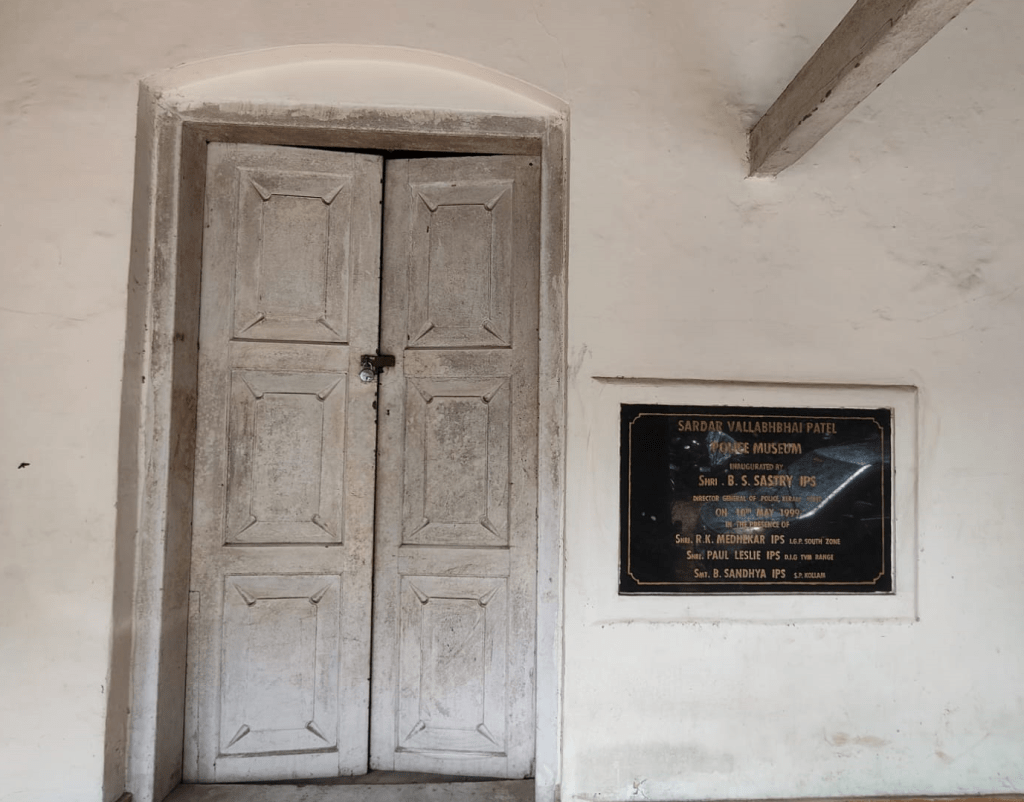
I snapped a few pictures and read the engravings on the wall.

I lingered around the statues for some more time and inquired about a few details from the people standing nearby. They confirmed that the museum was closed, but didn’t know when it would be reopened or if there were any plans for renovation.
I wondered… Why were they letting a once well-curated and well-run museum become a ruin? The spot and building looked apt. The images available on Google looked interesting and informative. Wikipedia even mentioned that the initial collection included bullets, guns, machines, various other weapons, information charts on DNA tests, human bones, fingerprints, snapshots of police dogs, and a variety of medals awarded to policemen of different ranks.
I also felt that the current state of the museum was sending a wrong message – about how paying homage to the police and martyrs is only for a namesake in our country, and such projects are deprioritized after the initial inauguration and photo-ops.
Maybe it wasn’t just the neglect of the authorities and lack of funds. Maybe the lack of enough visitors and support from locals like me was also part of the problem.
But I genuinely hope the authorities will renovate the place and reopen it soon. Until then, I think it’s best if the Kerala Tourism Department marks the place as ‘Closed’ on its relevant sites, to avoid disappointing tourists.
As I returned home by bus, I made a mental note not to let my shyness and introverted nature cause similar mistakes in the future. I can’t afford to visit every place twice. I don’t have the time or budget for that. I have to make the most out of each trip.
Last time, I inquired about the place from only one person; this time, I talked to more than four people. Communicating and asking questions is one crucial way we can learn from our travels.
Situational awareness is another key skill that we need when we go exploring a vast country like India. I hope to develop these skills more as I visit more places.
I also think about how we citizens can support the historical and cultural landmarks of our country. How can we rejuvenate similar landmarks that have been lost to neglect or lack of funds?
Currently, my country’s priority is reestablishing peace at the borders, deescalating tensions with Pakistan, and fighting its terror groups. But once peace is restored, what can we do to ensure some financial aid for this small museum?
Or am I being too optimistic about a democratic country with over 1200 museums and 4,000+ forts to safeguard? Well, a part of me is delusional enough to believe that once the peace is restored, if enough people asked the right questions enough number of times to the right people, it could still make a difference.
Author’s Notes:
~ All content on this blog is the intellectual property of the author. © 2025 Lirio Marchito. All rights reserved.
~ This blog is part of a series exploring my travels through my hometown, Kollam, a beautiful district in Kerala, India. You can read more posts from this series here: Kollam | Kerala | India.
 Lirio's Wanderings
Thank you for reading my blog! I’m always looking to improve my writing and your experience on the site. I’d love to hear from you. Please share what you enjoyed in the blog and what I need to work on in the comments. Your feedback really helps me grow. Thanks so much! 🙌
LikeLike