
Generally, once I come back from a trip, I stuff all my memories and photos into a jar of neglect and wait for at least a few months before sitting down to write about them. Like the crushed grapes stored in earthen jars by my grandpa, I want my memories to sediment, decay, and ferment before jotting them down as a blog.
Because, wise men say, time is a great editor. It filters out the irrelevant and the superficial, until only the distilled essence remains. But this time, I didn’t have the patience. Maybe because even plucked straight from the vines, grapes were fresh, tender, and sweet.
One of my close friends, whom I’ve only known for a bit over half a year now but with whom I share a sibling-like bond, suggested we visit the Iringole Kavu in the Kunnathunad Taluk of Ernakulam district in Kerala. It’s one of the 108 temples in Kerala, dedicated to Goddess Durga, and is located in the middle of a forest.
A Monsoon Trip
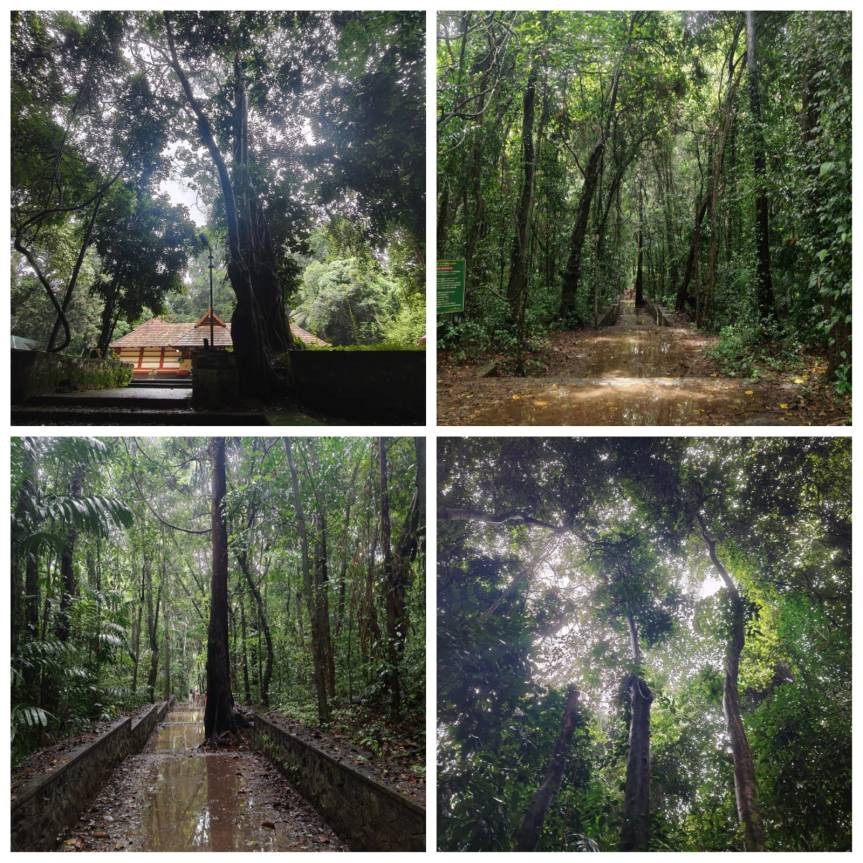
Even before reading the lore surrounding Iringole Kavu, my friend had bowled me over with the photos and Insta reels of its lush forest. Rain-kissed trees, muddy forest paths, grounds sponged with decaying leaves, big, black stone lamps (deepasthambhams), the cement steps leading to the temple, and the quaint temple itself piqued my interest. But there was a catch.
Any Kerala trip you plan in June is by default a monsoon trip. Despite the local knowledge, we were intimidated by the heavy rains, fatal lightning strikes, and orange alerts in Ernakulam and postponed our initial dates.
On 28th June, 2026, I hurried from my apartment to catch the 5:45 am private bus to the Kollam railway station, and groaned as the drizzle fell on my face and already wet hair. Like the red smoke in Neville’s rememberall, a mockery ran inside my head: “Dude, how can you forget your umbrella in peak monsoon?” Not one of my proudest moments.
There was only one other woman in the private bus. Any other time, I would have blamed the weekend and early hours, but I knew it was because of the newly announced Priyadarshini Free travel scheme for women in ordinary public transport buses.
Rain Scenes
By 6:15 am, I was hopping over the railway tracks towards the second platform, a hand over my head to shield myself from the raindrops. I settled on a drenched iron chair, waiting for my Venad Express, which was expected to arrive by 6:30 am.
I passed my time watching other people. Their umbrellas, pants, and shawls dripping, and rubber chappals and suitcase wheels squeaking as they walked through the wet platform or ran behind trains, determined to catch a particular coach or seat. A lean, tall senior lady who slipped on the opposite platform and the middle-aged men who casually covered their heads with white kerchiefs made me wonder if they had forgotten to carry their umbrellas, too.
Kollam-Aluva is a 155-kilometer, 3-hour-long train journey via the Kottayam route. Since my train ran late, I reached Aluva station only by 10:15 am.
My friend had boarded the same train on the way. While we were walking towards the exit, he accidentally slipped into a hole on the platform. Luckily, he wasn’t hurt. An elderly lady rushed to our side to enquire if he was okay. I was concerned too, but as is customary between friends, I had to troll him first.
We quickly enquired about the route to an autorickshaw chetan, before taking a detour to the nearest restaurant. After devouring two rolls, tea and a glass of Horlicks, we walked to the nearest transport stand. Walking from one end of the terminal to the other, we finally found a Perumbavoor bus.
Bus Journey
Since it was an ordinary bus with free travel for women, I warned my friend that we would never get seats. But I had to eat my words, as he scored the seat and even dozed off comfortably, while I stood for most of the route and had to settle for the free ticket.
There was a North Indian family on the bus. The two young women wore skirts and shirts, and had their faces covered with scarves. They had toddlers latched to their waists and carried two bulging school bags. They tried to shove a big sack beneath a seat, but eventually left it near the driver’s seat. One of them called her husband, not by his name, but as “Rahul ka papa,” her son’s father.
Once my friend and I got down at Perumbavoor, a grandpa who stood next to the lottery seller directed us to catch a Kothamangalam bus. The sweet pardha-wearing grandma who sat next to me on the Kothamangalam bus, the conductor, and the stranger who stood next to my friend, all alerted us when we reached our destination – the Pattal post office stop. We got down from the bus, crossed the road, and walked towards the Iringole temple.
On the way, we ogled at a European-style house named ‘Manchester.’ In the middle of discussing workplace dramas, the plot of an old Malayalam Dracula movie titled ‘Kalpana House,’ where the Dracula asks the local priest played by Oduvil Unnikrishnan to come back with more confidence, and debating whether shaving our heads bald will help to grow better hair next time, we reached the entrance of Iringole Kavu.
Spellbound
We stopped in our tracks, swallowing our words, awestruck by the beauty of the place. There was a symphony of creaking crickets, chirping birds, and rain drizzling down wet leaves all around us.
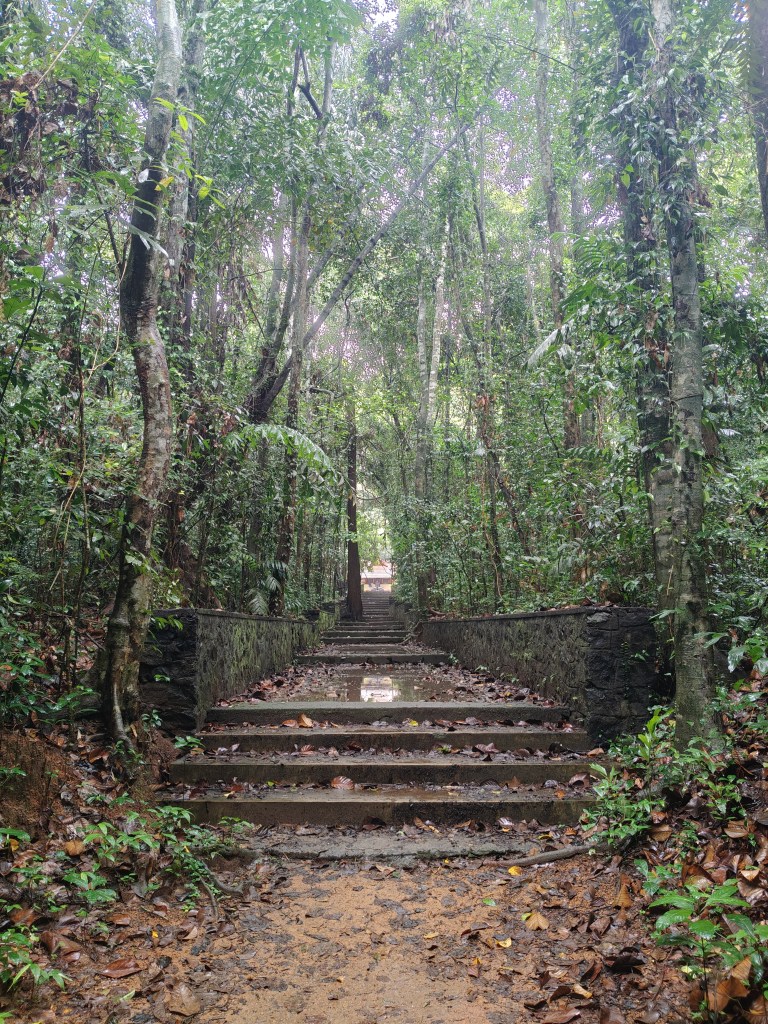
Unarguably, one of the most beautiful and soul-calming places I’ve been to in recent times. Like a master painter at play, God has thrown a hundred varieties of brushstrokes and even more hues of greens into his canvas.
The sky peeked through the densely packed tree roofs like a shy child. The woody tree branches were entangled like mating snakes.
Pond
The dark green pond had cobbled stone walls and cement steps strewn with fallen leaves and moss. All the clayey groundwater and rainwater must have seeped its way through the mud and tree roots to reach the pond, making it so pristine.
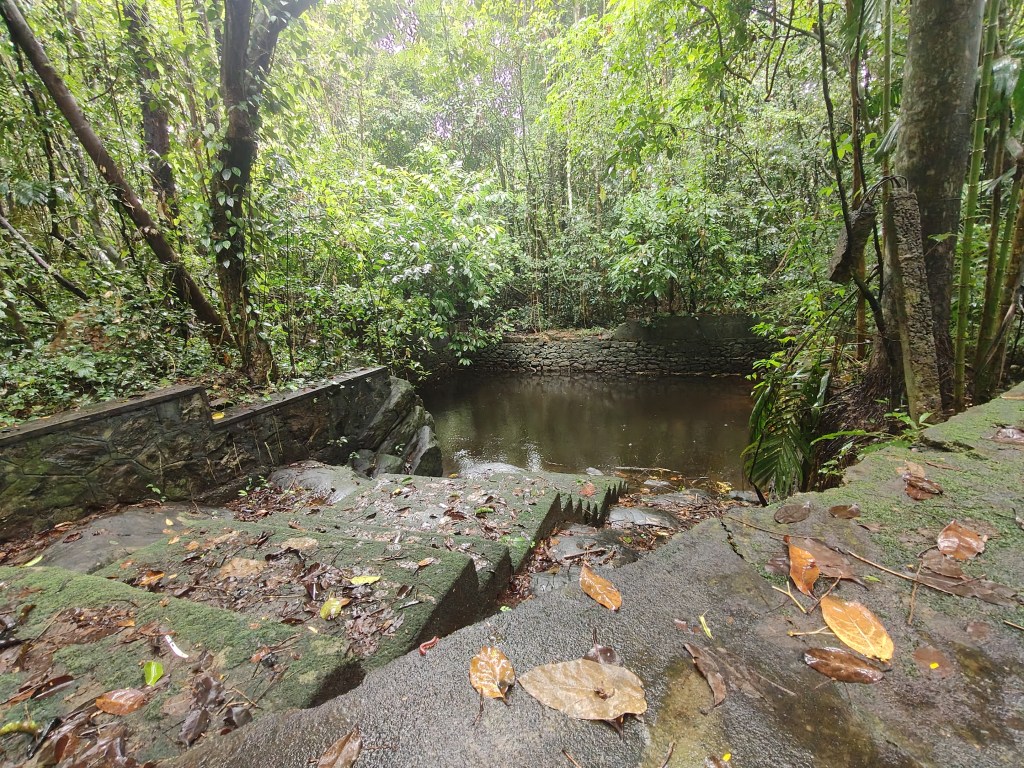
Why did the authorities have to lock the gates to the pond though? Maybe they worried the visitors might slip on the wet steps, get hurt, or worse, drown. After my last swimming fiasco at Chengannur, I wouldn’t have dared to enter the water. But I would have loved to sit on the last step, with my feet dipped in the cold water, watching the ripples.
Temple
We took off our sandals before entering the temple premises. As expected, the Iringole Sreebhagavathy Temple was closed. We had already seen a board mentioning the daily ritual timings as 5 am.
The cream walls, the brown-tiled roof, the tulsi plants, and the stone lamps made me wonder how the deity and the temple would look during deeparadhana (traditional Hindu ritual where oil lamps are lit at dawn or dusk for prayer).
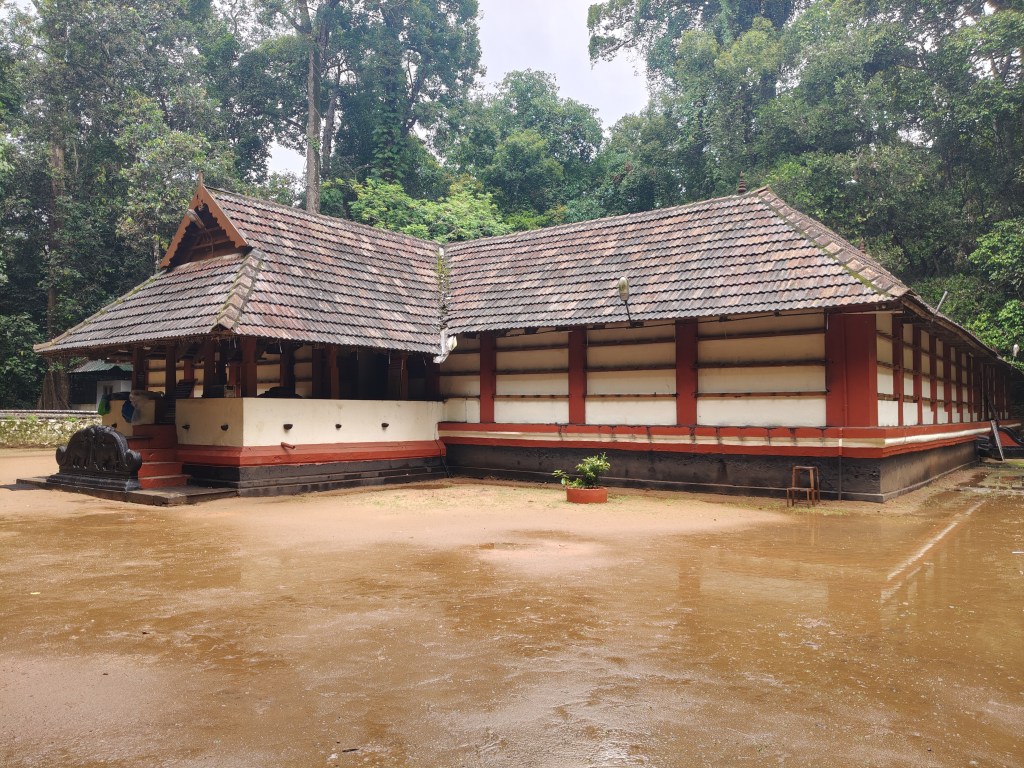
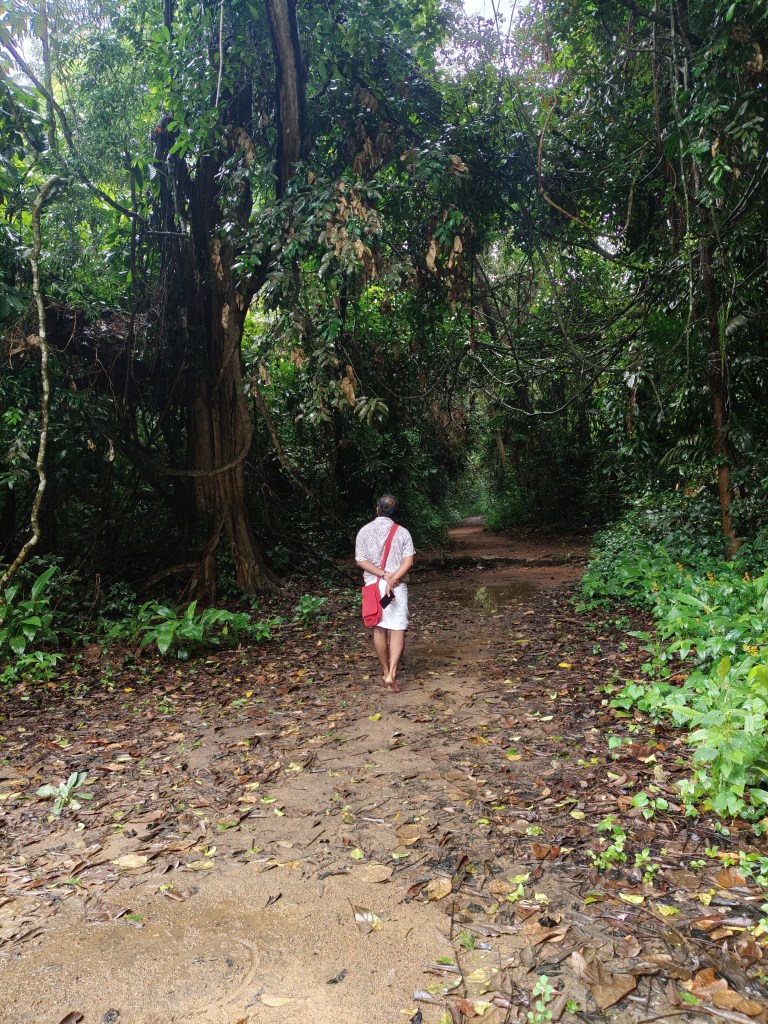
Since we couldn’t enter the temple, we decided to walk till the end of the sacred grove. Young ladies in ethnic wear, risking their saree pallus and skirt hems getting soaked in clayey puddles, and barefoot couples were either posing for photographers or exploring the forest.
Navigating the waterlogged, clayey footpath, with stones and pebbles, barefoot turned out to be uncomfortable. We groaned when we realized there was an alternate path to reach the forest area, without entering the temple premises. We could have worn our sandals.
Sacred Grove
Nonetheless, we walked all the way to the end of the grove, marked by a deepasthambham. On the way, we watched seniors in mundus and kasavu sarees praying to a pala tree, believed to host yakshis and gandharvas.
I collected a few panamkuru – seeds of the palm trees – in my bag. I usually collect kunnikuru and manjadis, but this was my first time truly noticing panamkurus, so I felt I had to commemorate it.
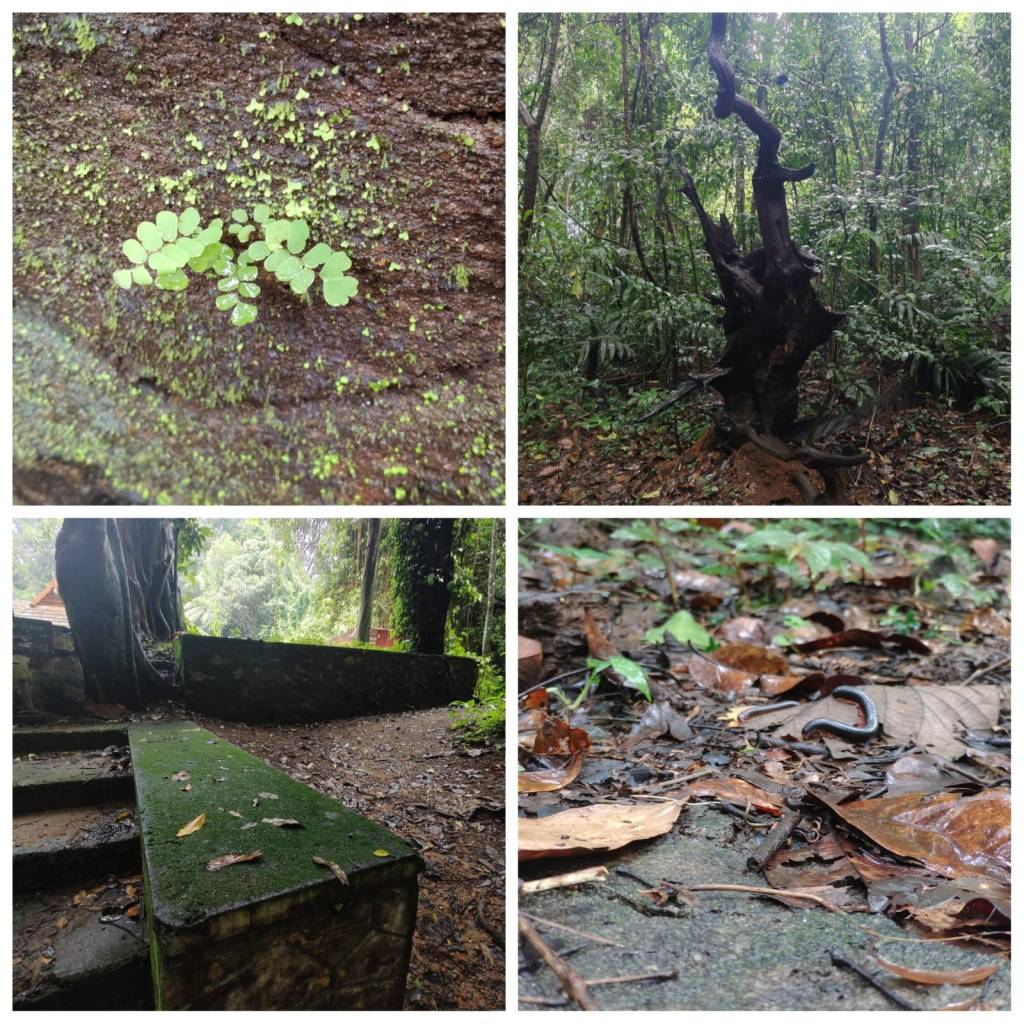
I zoomed my mobile camera lens on leeches curling on fallen wooden trunks and tiny ferns growing in the cracks of walls. I couldn’t help but laugh at my own contradictions. I chased a lot of big dreams and societal expectations for three decades, only to feel happy at the sight of silly mosses and grasses. How random and unpredictable is life!
The song that was running through my head at this point was ‘Akale oru Kaadinte’ from the Malayalam film ‘Ramante Edanthottam.’ We could easily shoot a music video or short film with a romantic theme in this location.
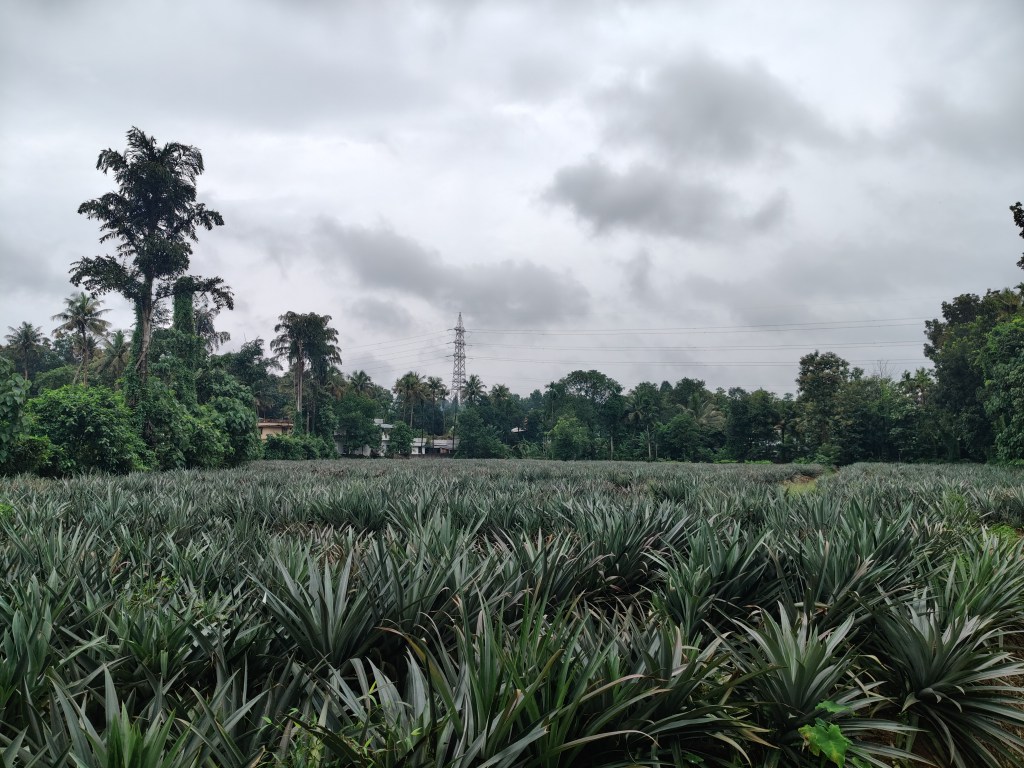
But the big headless tree that stood right in the middle of the main path, the dense forest around us, the isolated pineapple farmland on the side, and the snake pits also made it an apt location for a horror or even time-loop themed sci-fi short film.
In between, my friend got hijacked by a lovely couple to take their photos and videos. He thoroughly enjoyed the assignment, experimenting with all his favorite camera angles and reel ideas. Meanwhile, I spoke with Sadhanandhan Chetan, who introduced himself as the temple committee president and a lover of E.M.S. and Kerala history.
Lore of Iringole
In Hindu Mythology, Kamsa, the tyrant ruler of Mathura, imprisoned his cousin Devaki and her husband Vasudeva, fearing the prophecy that their eighth son would murder him. Determined to save their eighth son, Lord Krishna’s life, the young parents shifted the baby boy to Vrindavan and instead kept a baby girl in the cradle.
Realizing the mix-up, Kamsa furiously lifted the baby above his head to kill her. Miraculously, she glided out of his hands, turned into a supernatural power, and stayed suspended in the air.
Legend says the same power resides(Irinnole) in this temple, and other gods and goddesses surrounded the temple in the form of trees and plants to worship her. Later, this place grew into a thick, beautiful forest and got the name ‘Iringole.’
The lore claims the deity is an incarnation of the illusory Maya or Yaga-Nidra, and that it exists in not one, but in her original three forms of power – as Saraswati, or the Power of Knowledge, in the morning; Vana Durga, or the Power of the forest, in the afternoon; and Bhadrakali, or the Power of Fury and termination of evil, at night.
Worship
Sadhanandhan Chetan mentioned that the temple and forest, comprising around 56 acres of land, are part of the Nagancheri Mana and run by the Devasom Board. I was intrigued when he mentioned it’s one of the largest sacred groves in South India, that too, located within a municipality.
Sacred groves are generally biodiversity hotspots for flora and fauna. But sadly, there are no wild animals in this semi-evergreen forest. Sightings of snakes are also rare. But it does host varieties of trees and plants. Chetan pointed out wild peppers and the shrubs of Chittamrutham(Giloy) to me.
Since I couldn’t enter the temple, he painted a picture for me. There’s only one deity inside the temple – the Goddess – and no minor deities or Upaprathishtas. Since the Goddess is a shanthaswaroopini – in her calm and graceful form – people offer her flowers like chethi (Jungle Geranium), thamara(lotus), and thulsi. I could see torn banana leaves on the steps with sandalwood paste and flowers.
Mana
By that time, my friend was back, and Sadhanandhan Chetan suggested we explore the Nagancheri Mana before leaving. He showed us the path through the forest and suggested we wear footwear before venturing on it.
On the way to collect our footwear, we saw red pagoda-like flowers. While photographing it, my friend mentioned that its local name was Krishnakireedam(Lord Krishna’s crown). I chuckled, forming a conspiracy theory in my head.
What if these plants were Lord Krishna himself, guarding his sister, in return for her sacrifice? What if the other gods and goddesses, in the form of trees and plants, were staring back at us and even judging us with their mischievous, all-knowing celestial eyes, as we walked through the forest and photographed them? Eerie, isn’t it?
To be continued…
Author’s Notes
~ All content on this blog is the intellectual property of the author. © 2026 Lirio Marchito. All rights reserved.
~ This blog is part of a series exploring my travels through Ernakulam, one of the 14 districts in my home state, Kerala, in India. You can read more posts from this series here. Ernakulam | Kerala| India

 Lirio's Wanderings
May your passion for travel take you to extraordinary places and may your words continue to inspire and connect people across the world. Best wishes always.
LikeLiked by 1 person
May your passion for travel take you to extraordinary places and may your words continue to inspire and connect people across the world. Best wishes always.
LikeLiked by 1 person
Thank you so much 🤍
LikeLike