
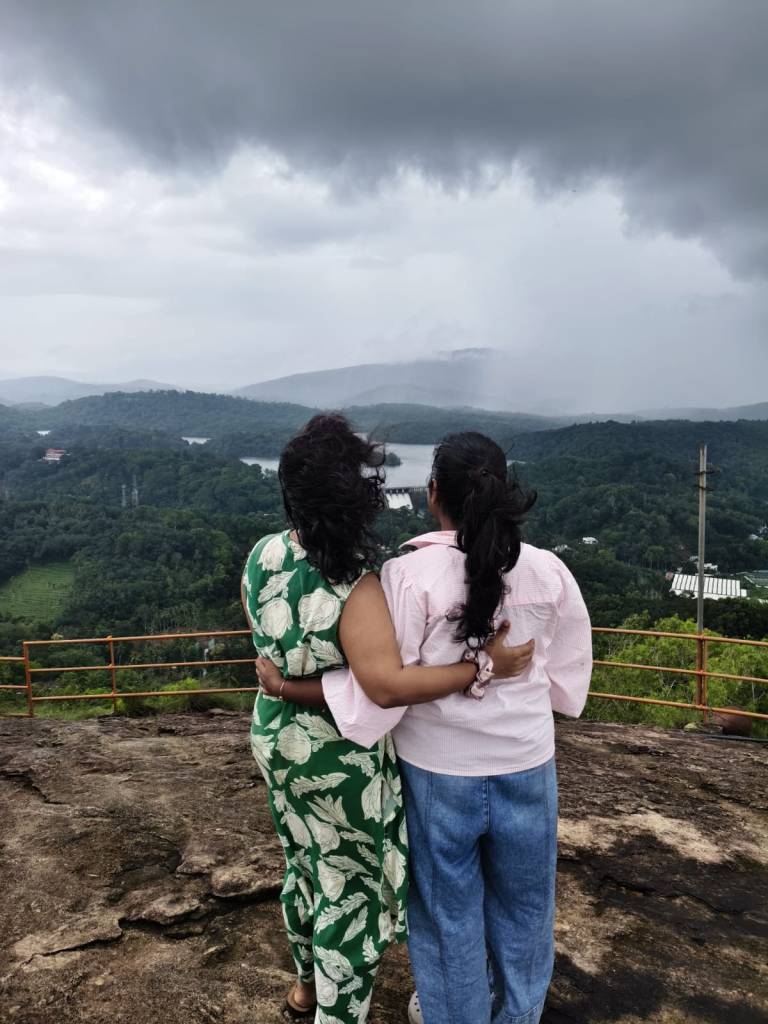
Since my travel and write-ups mainly focus on less-in-vogue local spots in Kerala and slow, sustainable tourism, I don’t expect any of my friends to read my blogs or to get inspired by my experiences. So imagine my surprise and joy when one of my school friends, Bhagu, read my Kathirmudi Trek blog and asked if she could accompany me on my next trip.
Even though we have known each other for more than 20 years, we had never gone on a trip together, except for the short, shared car rides to our friends’ weddings.
Since it was the time of the Southwest Monsoon, or Edavappathi, in Kerala, we decided to go on a monsoon walk organized by Appooppanthaadi, a travel group based in Trivandrum known for its budget-friendly trips for women. We zeroed in on their one-day trip to Amboori, a lusciously green village located at the southern tip of the Western Ghats. A part of the Kattakada Taluk in Thiruvananthapuram district, this small village is famous for its hills, dense forests, quaint waterfalls, adjoining Neyyar Wildlife Sanctuary, Neyyar Dam, its reservoir, and tribal settlements – especially the Kanikar community.
What I Packed
Since it was a monsoon walk, we were advised to carry an umbrella/raincoat, an extra dress, a towel, a sanitizer/salt to ward off leeches, energy bars, a bottle of water, and to wear clothes and footwear suitable for wet, marshy terrain.
A Rainy, Late Start
I was supposed to reach Trivandrum by June 12th, 2026, Friday, and stay at B’s place. However, due to work commitments, I had to push my Kollam-Trivandrum journey to the next day, that is, June 13th, 2026, Saturday, the day of the Amboori trip.
The night before the trip, it was raining cats and dogs, and my anxiety ensured I tossed and turned on the bed till 2 am. At 3:30 am, my sister, my favorite and most reliable alarm person, gave me a wake-up call. By 5 am, I sneaked out of my house with my backpack and umbrella in hand.
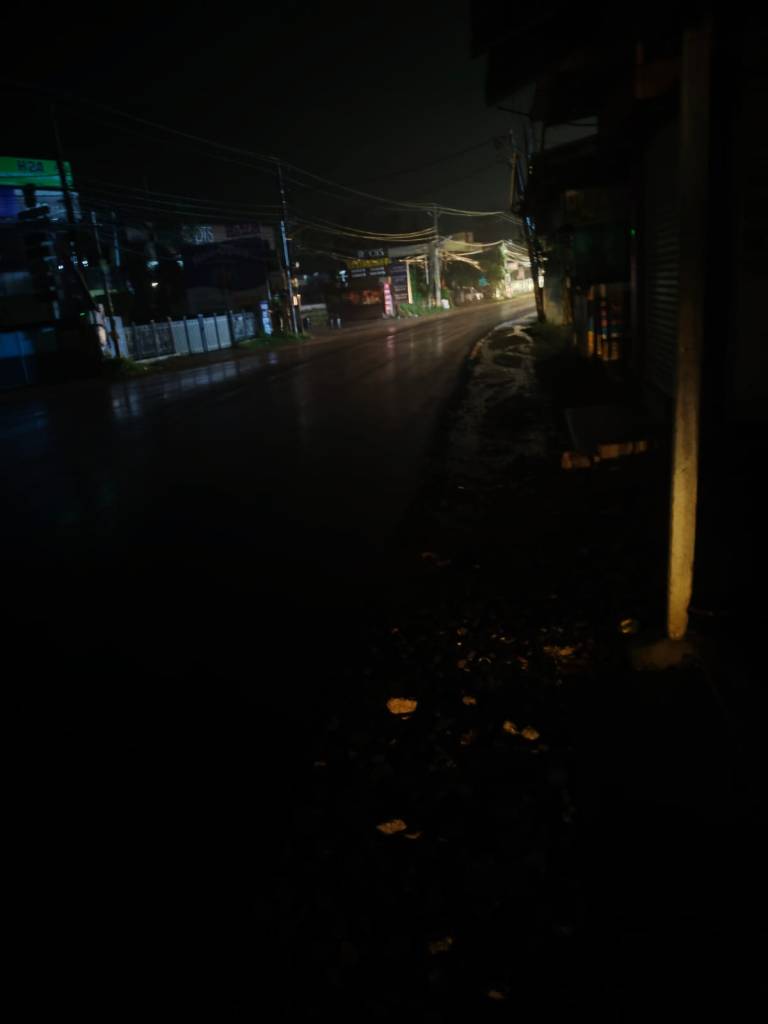
Unfortunately, I made the mistake of waiting at the wrong bus stand. Neither did the Trivandrum fast or superfast buses stop there, nor did any ordinary or private buses come for the next 30 minutes.
Waiting at the wrong places gets you nowhere, literally. So I gave up and walked to the nearest main bus stop, Ramankulangara. Luckily, by 5:40 am, I boarded a Trivandrum Fast Passenger bus and bought a Rs 99 ticket to Thampanoor, relieved by the driver’s speed and the lady conductor’s assurance that the bus would reach my destination by 7:45 am.
Travel Buddies
The trip kick-started at 8 am sharp from the Thampanoor railway station entrance. Thanks to the bus driver’s diligence, I made it on time. I was so happy to see Bhagu after over a year, and to make the acquaintance of 15 other lovely ladies who joined the trip. Most of them were from Trivandrum, except for one or two who were based in Ernakulam and Thrissur.
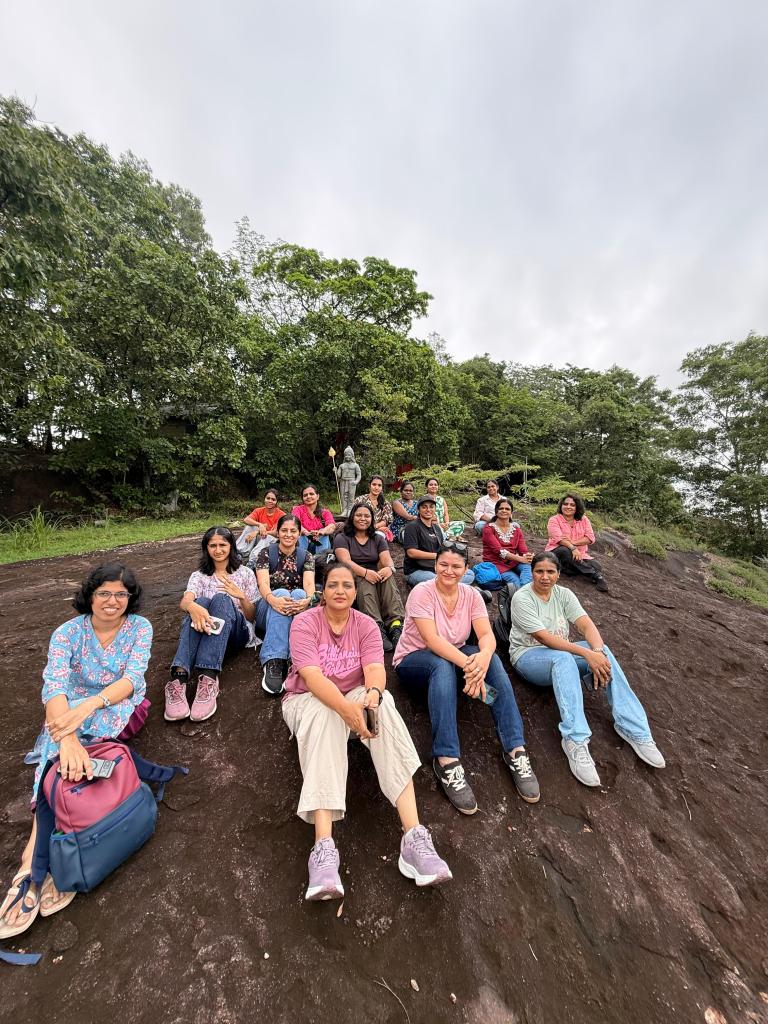
Our coordinator for the day, whom Appooppanthaadis affectionately calls “buddy,” was Reshma, an IT professional who worked remotely for a Bangalore-based company. She is a native of Thalassery, in Kannur, now settled in Trivandrum with her family.
As soon as we boarded the traveller, Reshma gave us a brief of Appooppanthaadi’s journey. All of us clapped when we learned that it was their 1035th trip. She also mentioned the hardships the founder, Sajna Chechi, and her team had to tide over in the last ten years to keep the company afloat.
During self-introductions, I learned that many of the travellers worked in highly sought-after fields such as IT, Marketing, Banking, and Medicine. There was also a mom-school-going-daughter duo and a fellow Malayalam language expert in the bunch.
Though there was a young woman who had gone on 30+ trips with Appooppanthaadi, and another who had been to every Indian state except two, the majority of others had a common sad tale to share. Stories of how their parents or partners curbed their travel dreams, citing safety concerns and financial limitations, or simply by being consistently discouraging and uninterested.
I couldn’t believe that grown-up, educated, working, financially stable women like them were still restricted from pursuing travel for leisure. Then what would be the state of women from low-income families, who are financially dependent on their parents or partners? I hope the new Kerala Chief Minister V. D. Satheeshan’s decision to provide free travel for women in ordinary buses increases the socioeconomic progress and mobility of Keralite women.
A Local Guide Joins
I noticed that our traveller was passing through the Karamana-Kattakada route. At Kattakada, Mr Saji, our local guide, joined us. By 9:30 am, we reached the first stop on our list – Kalipara.
Kalipara
A steep half-kilometre climb to the top of Kalipara intimidated most of us at first. However, it turned out to be manageable thanks to the handrails, ropes, stairways, and occasional stone-cut steps. Not to forget the support of our buddy, guide, and the camaraderie among the travellers.
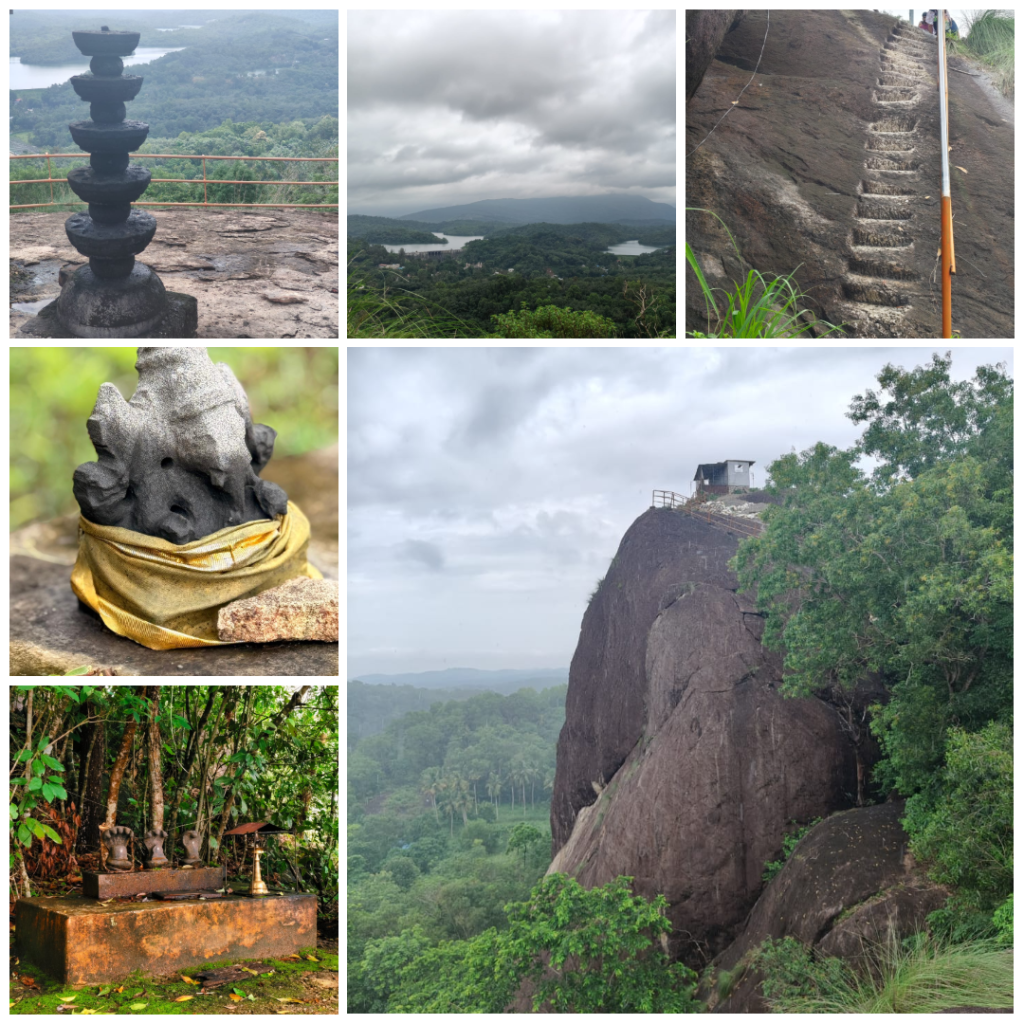
Still, the rain left slippery spots on our track that we had to be extra careful about. There were small statues of Lord Ganesha, Murugan, and Nagas on the way that piqued our interest. The view from the top, at a height of 1200 feet, was the cherry on the cake.
Neyyar Dam – Shutters Opening
From near the Murugan statue, we could see a stellar view of the Neyyar Dam. It is a gravity dam constructed over the Neyyar River. The water from its reservoir flows to the Karamana River and many other water bodies in Trivandrum. While resting at that spot, clicking photos, munching on biscuits, and slurping down water to replenish our energies, we heard the alarms blaring from the dam.
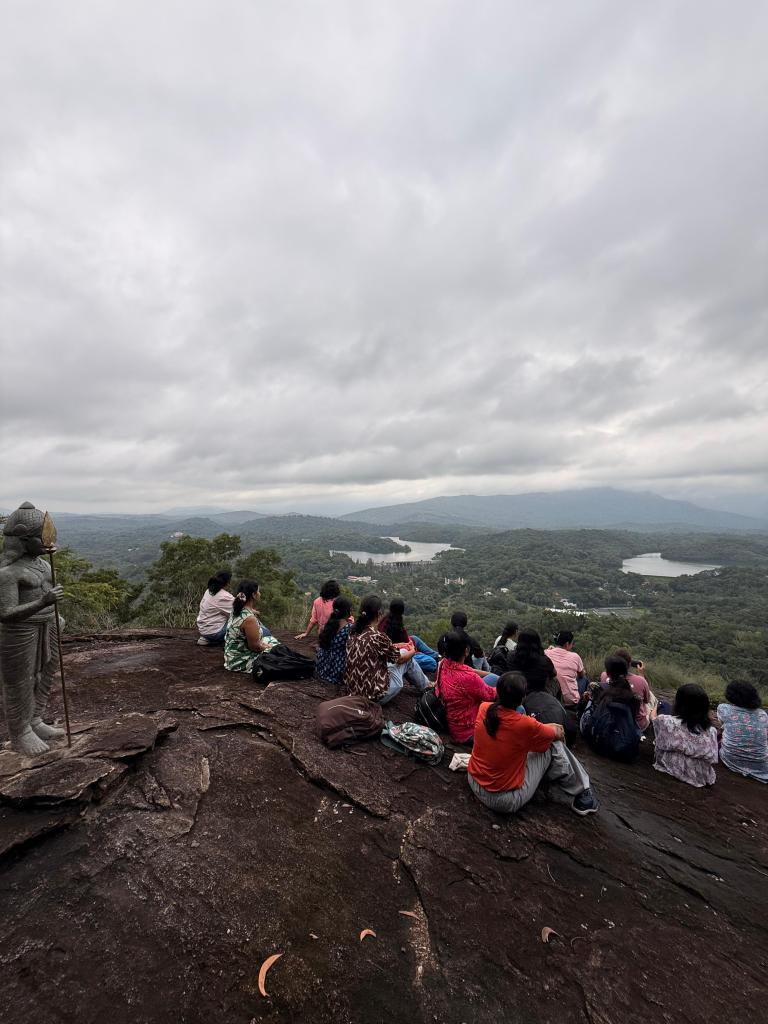
Saji Chetan informed us that two days of constant rain had filled the dam, so when the third alarm blares at 10 am, all four shutters of the dam will open. Since it was just ten minutes away, all of us settled down on the rocky surface and awaited the third alarm.
Due to the bus fiasco, I had arrived at the hike empty-stomached, so my body was drained of energy. While the rest of my gang was camera-ready for the anticipated moment, I was busy stuffing biscuits into my mouth.
Suddenly, the third and final alarm blared, opening all four shutters of the Neyyar Dam one by one. Water rushed down, gurgling so loud, like a beast unchained. From where we sat, it looked like a waterfall of foam.
Agasthyamuni Cave
After watching the glorious shutter opening, we resumed our steep climb to the cave areas of Kalipara. Once we reached the area, we had to walk through a narrow passage between big rocks.
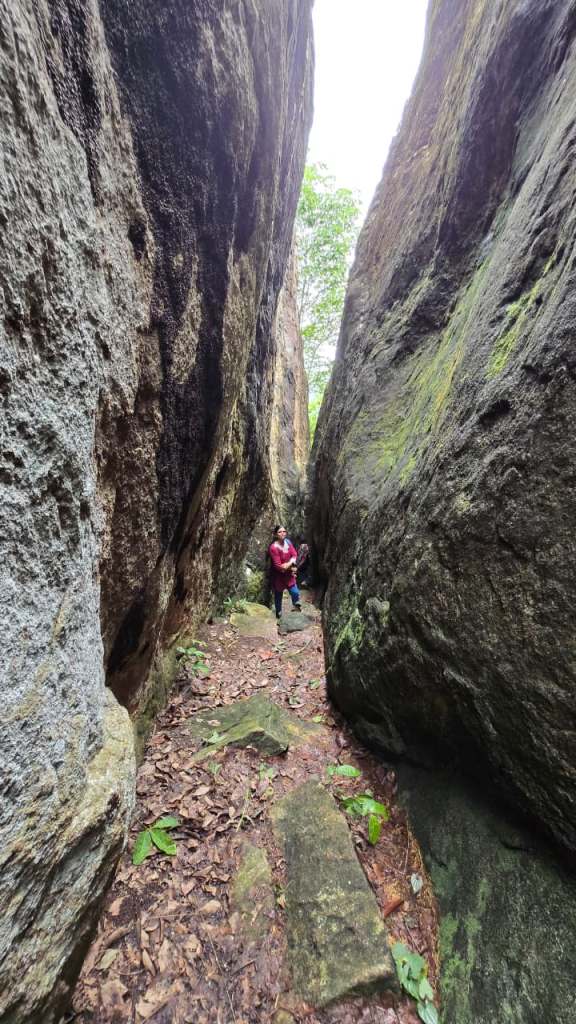
For a moment, the path suffocated me, forcing me to look up at the sky for reassurance. The height of the rocks intimidated me further. For a split second, it reminded me of the Guna Caves in the blockbuster Malayalam survival thriller movie Manjummel Boys. Of course, it was just my anxiety exaggerating my fears.
Another thing that made me uncomfortable was the swarm of black beetle-like insects resting on the cave walls. From a distance, they seemed like wet, black patches of mold. But if you looked closer, you could hear them buzzing. While passing through the narrow way, we had to be careful not to disturb them with our bodies or shoulder bags.
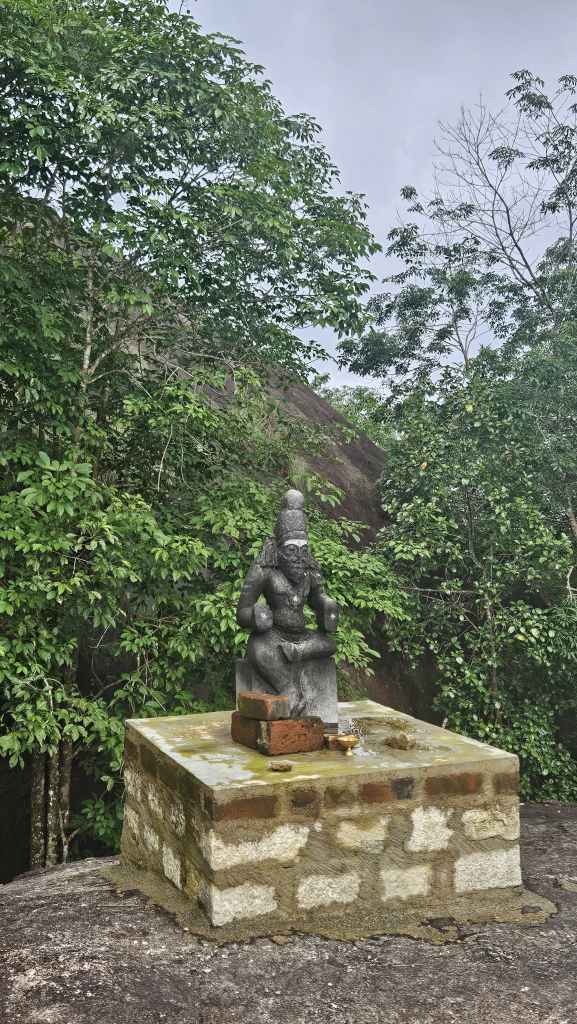
Outside the cave area, there was a statue of Agasthyamuni. On one of the holes in the cave’s surface, there was a padduka, a wooden sandal, and a stick, a danda, symbolic of Hindu Sanyasis or monks.
Despite all the discomforts, this cave area was my favorite spot in the entire trip because of its element of adventure.
The Sree Kalipara Lokambika Temple
After exiting the cave, we retraced our steps back to the Murugan statue. Instead of descending, we climbed an alternate path on the side to a temple at the top. Saji Chetan told us that the deity in the temple is Lokambika, and that the temple opens for prayers on every Sunday and the first day of every month. According to local lore, the Kani tribe, who dwelled in the mountains, used to worship this deity.
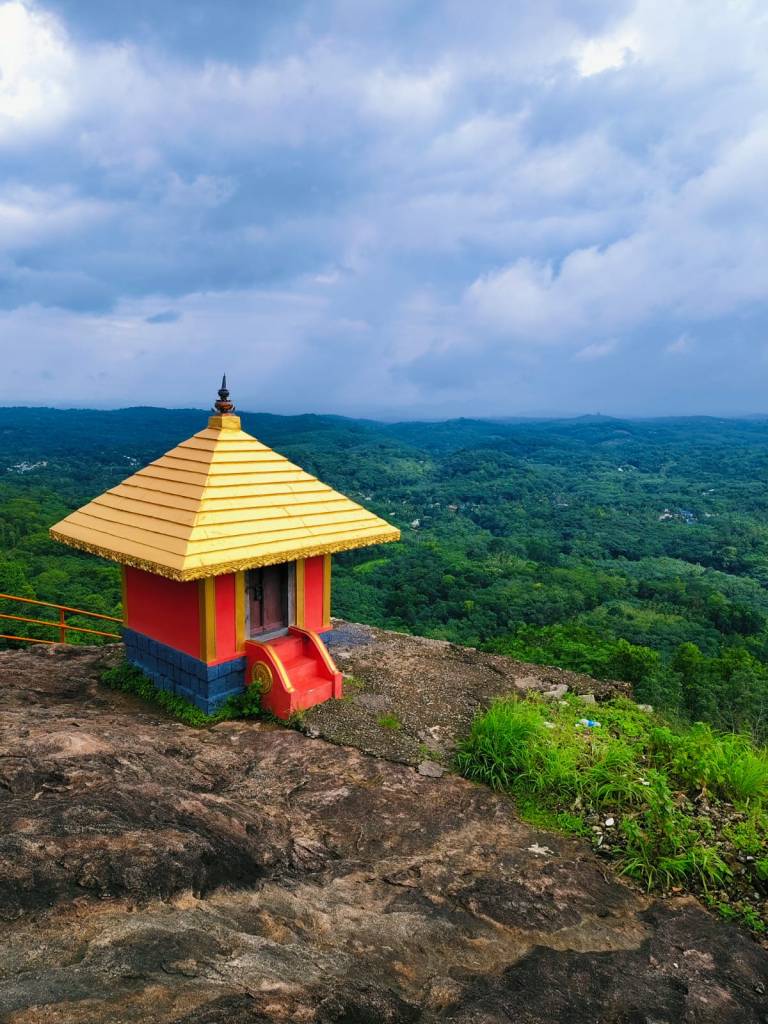
While we were enjoying the view and busy clicking photos, the wind started blowing harder, and the clouds turned darker. Expecting heavy rains, we quickly put on our raincoats, but, fooling us, the sky settled for a short drizzle.
During the down trek, we scrambled up more rocks and posed for pictures. As we struggled to descend, our buddy turned our scared attempts into funny reels with the comic voiceover of Malayali actor ‘Suraj Venjaramoodu’ saying “Eda, ithu anganeyonnum allada” (Bro, that’s not how it works!) and “Namuk veetl ponde?” (Don’t we want to get home at some point?)
To be continued…
You can read the second part of the blog here.
Author’s Notes
~ Ownership of all group photos and nature images belongs to the individual hikers or Appooppanthaadi.
~ All other content on this blog is the intellectual property of the author. © 2026 Lirio Marchito. All rights reserved.
~ This blog is part of a series exploring my travels through Trivandrum, the capital city of my home state, Kerala, in India. You can read more posts from this series here. Trivandrum | Kerala| India

 Lirio's Wanderings
2 thoughts on “Amboori – A Monsoon Walk with Appooppanthaadi – Part 1”